Graphics, the basis for the divulgation and transmission of data, translate a series of complex numbers into an easily interpreted visual construct, thereby making them immediately understandable.
However, this process of democratization of data exploits only one medium: sight.
Graphics have dominated every aspect of divulgation and research for many years, thus almost entirely excluding anyone with visual impairment from these areas (especially on social networks). The alternative, tactile graphics, has limitations that make it difficult to use in daily life.
In this panorama, so closely bound to the visual medium, we decided to test the efficacy of sound as a means to represent data, and therefore launched the “Solar Community Orchestra” project.
The project, developed in the context of the Master’s thesis "Data Sonification: sound as a new means for the divulgation of sciences” for the course “Teaching and communication of natural sciences” in Academic Year 2023/24, presented by Matteo Cavalli (Master’s degree in Teaching and Communication of Natural Sciences, University of Bologna) and supervised by Prof. Laura Corazza (Professor of Teaching and Communication of sciences at the University of Bologna), is based on a technique known as “data sonification," consisting of the creation of audio tracks or “songs” obtained by faithfully translating the starting data.
In our case, we used data regarding solar energy consumption in the city of Medicina (BO), kindly provided by the Center for Solar Communities, based in Medicina.
Starting from these data, we created a duet in which one melody line represented the consumption of energy generate by the solar community and the other represented the energy taken from the national electrical grid. What sound did the data make?
Data Sonification and the Solar Community Orchestra (https://www.youtube.com/ ).
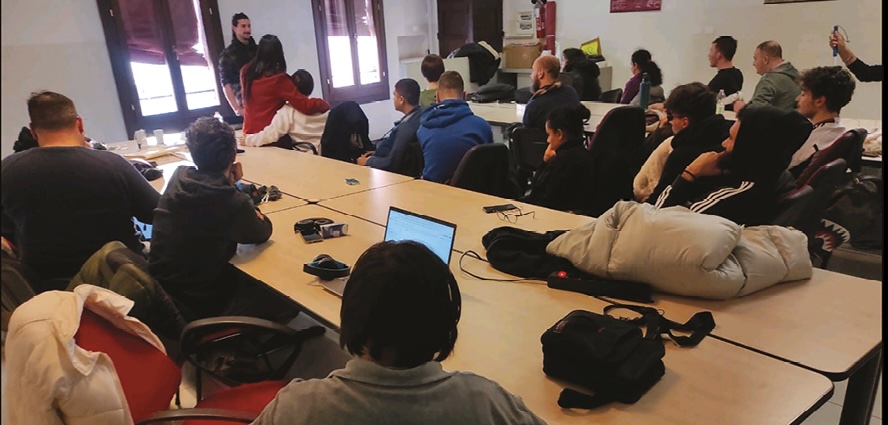
This sonification was presented to the students of the Francesco Cavazza Institute for the Blind, who enthusiastically offered their opinions, suggestions, and doubts, providing us with a very long list of ideas to make the sonification more effective. The presentation was preceded by a brief introduction explaining what data sonification and solar communities are, followed by a description of, and reasons for, the sounds chosen for the two melody lines. The students then heard how the tracks were created and listened to the two separate tracks.
The wealth of feedback received revealed a view of the technique more pragmatic than that of a sighted audience, confirmed by the students’ suggestions and doubts: despite the fact that they appreciated the esthetic aspect of the creation, they stressed the importance of making the technique more precise.
Although sonification has a long history, it has never received very much attention. Clearly, it can be an important medium for scientific divulgation, especially in the context of typhlology, where the suggestive power of music and sound unites with a need for complete detachment of the currently prevalent visual medium.
Future research and testing will be fundamental for improving this technique, overcoming its gaps, and further refining the creative and design process in order to obtain sonifications that can be easily enjoyed by everyone and ensure a new dimension in which to explore an ever-growing amount of data.
 Italiano


.png "Aderente alla Consulta tra le Antiche Istituzioni Bolognesi")