The Tolomeo Museum was founded as a place of research and experimentation, where the perceptive experience becomes a form of knowledge and relation.
It’s not a museum that displays only objects, but one that displays processes of knowledge: the building of senses, forms of memory, the imaginative ability that derives from the encounter of body and world.
The Tolomeo Museum’s work is performed at the crossroad between education, accessibility, and prototyping of cognitive and sensory devices.
Based on typhlo-didactic and pedagogical theories, the museum works in a variety of contexts – schools, museums, cities – to build devices that make sensory and cognitive experiences shareable and to promote inclusion by bringing people together while respecting their diversity.
In this perspective, blindness is not an absence but a cognitive condition that allows examination of the perceptive hierarchies that everyone shares to an unequal degree: seeing, touching, listening become equivalent acts of exploration and building of knowledge.
The core of every project is a 3-step process:
1. the perceptive act, as a direct and situated experience;
2. the imitative response, as a corporeal and linguistic translation of the experience;
3. development of the imagination, as a space in which knowledge expands and regenerates.
This process, employed in every museum activity - tactile laboratories, inclusive installations, exhibition design, etc. - is an action-based epistemology: a way of thinking by means of, and with, the body.
Every educational gesture becomes a phenomenological experiment.

When a person gets to know an object by means of their hands, this is not simple learning, but instead an act of embodied knowledge.
Therefore, the museum becomes a shared space for building knowledge, where perception is transformed into narration and narration into mental image.
The Tolomeo Museum translates the principles of active pedagogy and of phenomenology of perception into concrete design practices: the arrangement of spaces, choice of materials, organization of courses, and durations of experience are conceived as an integral part of multisensory training.
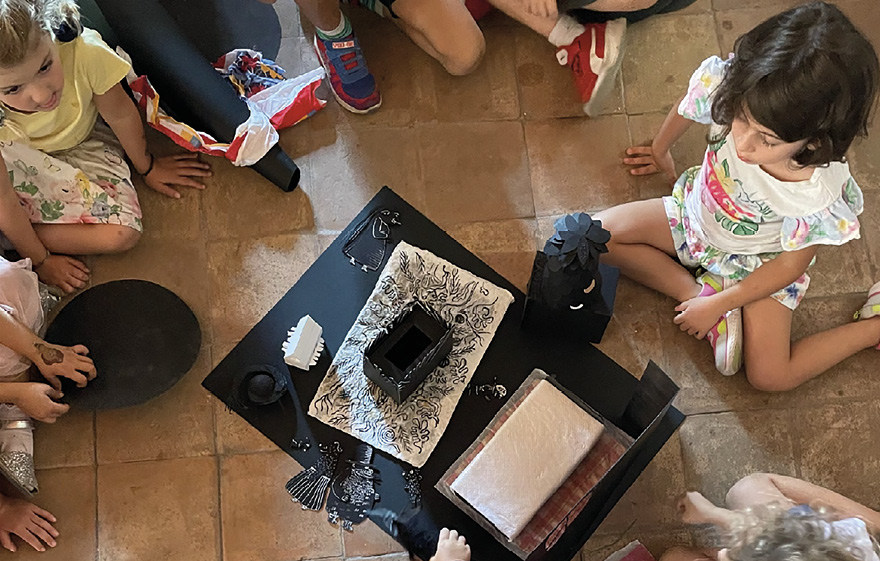
Every setup, every laboratory, every cognitive and sensory device is an act of reflection on knowledge, a way to understand that thinking means relating.
The Tolomeo is a museum in motion: a laboratory of experiences that moves through cultural sites and makes them accessible, inclusive, and cognitively open.
In a world dominated by images, it restores value to gestures, to touch, to the shared word.
It encourages a pedagogy of attention and an aesthetic of reciprocity, where knowledge is not contemplated but exercised, and where it becomes a form of care toward oneself, toward others, and toward the space we live in.
 Italiano

.png "Aderente alla Consulta tra le Antiche Istituzioni Bolognesi")