Talking about the Via Emilia doesn’t mean describing a road. It means following a thread that passes through centuries and landscapes, letting yourself be carried away by never-ending movement. It’s not a line of asphalt: it’s a story that rewrites itself with every step, a landscape that opens up to anyone who knows how to look from different angles. Italo Calvino said that the gaze is never fixed, even when we aren’t moving: writing about a road means following its curves in your mind, moving through its epochs, listening to its submerged voices. The Via Emilia is a voyage through time: Roman wagons making grooves, medieval merchants, pilgrims, up to modern cars that travel on it without realizing that memory still throbs under its asphalt.
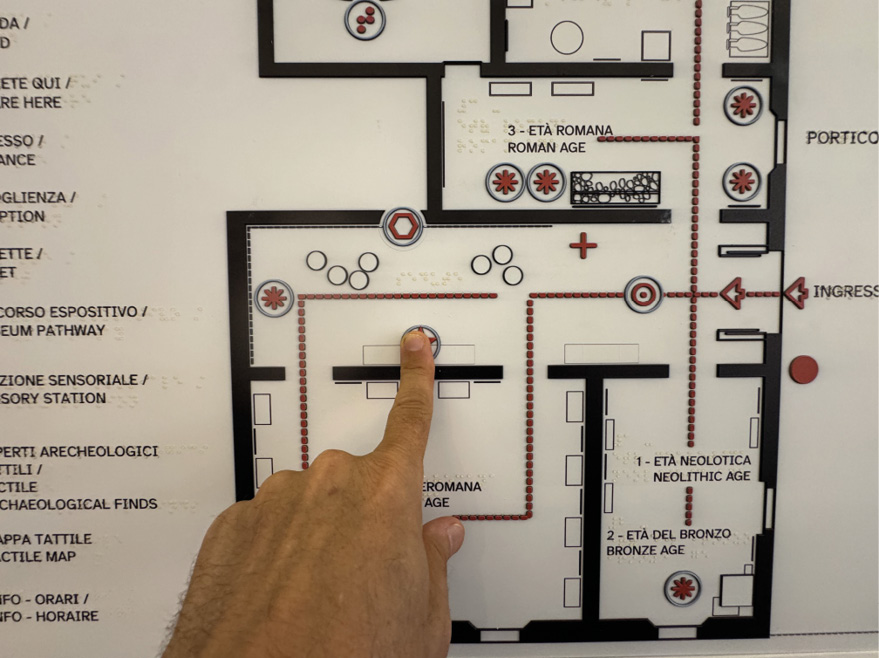
Every stone tells a story, creating a living manuscript that belongs to those who watch it and to those who dream it. The Archeological Museum of Castelfranco Emilia, redesigned as a modern viatory location, is part of this landscape in motion: not a stopping place, but a point of departure. Just as the Roman road connected places and people, the Museum connects times, languages, and sensibilities, offering visitors the ability to move around by themselves, without any barriers. The museum is accessible and welcoming: the tactile flooring guides the blind, and two visual-tactile maps (one for the interior and one for the territory) invite guests to wander freely and return. The booklet, in digital format and in Braille, opens the way toward cities, countrysides, and train tracks. It's therefore a hub that gathers what was and that launches it toward what will be. The heart of the project is the artisanal act, and in the various rooms you can explore tactile copies of artifacts created by the Francesco Cavazza Institute’s Tolomeo atelier. Objects “made with the hands for the hands.” A simple and ancient act: the person who shapes the material anticipates the movement of the person who will one day touch it to know it. Touch has memory and consciousness: it can follow surface, recognize reliefs, read details. Touching gives back stories that the eyes don’t see. A profound transfer is performed in this silent passage from the gesture that creates to the one that discovers. The museum becomes a laboratory of experiences, a space where archeology meets the imagination. Every artifact, every tactile copy, every trace of the past is not just testimony, but the start of a new story. The Via Emilia is once again not mere infrastructure, but a matrix of experiences, a line connecting eras and people. It still reflects local identity: a living road that is more than just driven on, but that runs through us and bestows its stories on us. It is no coincidence that writers, musicians, and photographers have chosen it as a subject. Luigi Ghirri saw it as the region’s backbone; Gianni Celati made it narrative theater; Francesco Guccini evoked it as the border between roots and desire. Everyone recognized the same principle: the Via Emilia is never just a place, but a weave of memories and dreams.
 Italiano



.png "Aderente alla Consulta tra le Antiche Istituzioni Bolognesi")