The story of the Contavalli Theater began on March 10, 1810, when Antonio Contavalli, whom Guidicini called “an unscrupulous property owner who amassed a fortune by taking part in illicit trade in sales of domestic assets,” acquired part of the Carmelite Convent in St. Martin’s Church. He decided to build a theater there, assigned the project to Giovanni Battista Martinetti (one of the time’s most famous architects), and inaugurated it on October 3, 1814 with Carlo Coccia’s opera “La Matilde.” The theater sat 800, with parterre and three tiers of balconies, was completely decorated, and offered a successful program every year from about February to throughout the summer.
When the Papal States reassumed control of Bologna on August 2, 1815, Guidicini’s prophesy seemed to come true: “the theater is small and fairly elegant, but its location will make it poorly attended.” In fact, the theater was closed by order of the curate of St. Martin’s Church, so certain of finally eliminating a site of profane perversion as to state that he would eat a live donkey if the theater ever resumed giving performances. The curate didn’t consider the determination of the theater’s owner, who traveled to Rome to present the Secretary of State with his petition for reopening and, after receiving permission, sent the defeated curate a perfectly cooked young donkey!
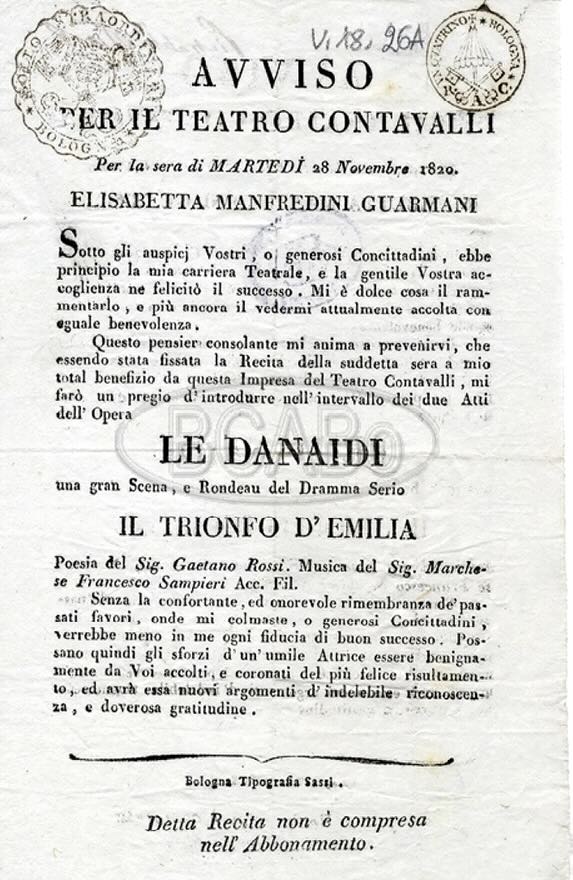
So, in July 1816 the season reopened with a surprise: the first Bolognese performance of Rossini’s “Barber of Seville,” with no less than contralto Geltrude Righetti Giorgi, who had sung at the work’s premiere in Rome that February. The Contavalli thus became one of the city’s most important opera houses, and Rossini’s works alternated with those of the era’s most celebrated composers, such as Giovanni Tadolini, Francesco Morlacchi, and Giuseppe Mosca. To entertain audiences, composed of the lower and middle class and of student from the nearby University, opera alternated with comedies and tragedies proposed mainly by amateur playwrights and actors ethologists, and puppeteers from local societies, which often included figures involved in Risorgimento uprisings, such as Augusto Aglebert, patriot, writer, one of the defenders of the Republic of Venice and of Rome, Agamennone Zappoli, a follower of Mazzini who took part in the 1831 and 1848 uprisings, and Gustavo Modena, whose support of Mazzini forced him into exile, and who returned to Italy only to take part in the 1848 uprising.
In the early 1850s, the Contavalli overcame the crisis that had struck other Bolognese theaters, and widened its assortment of performances, alternating drama and opera with variety, and marionettes both of wood and … “live”! On stage there arrived Persutéin Gambozz, the Bolognese stock character impersonated by Luigi Scorzoni, a regular part of the programming that gradually lost its appeal toward the end of the century. In the 20th century, “with its faded golds and insipid velvets, the theater’s audiences are interested mainly in tortelli and lambrusco.” In 1938, the Contavalli became a movie theater (X-rated after the war), and closed permanently in 1979.
 Italiano



.png "Aderente alla Consulta tra le Antiche Istituzioni Bolognesi")