The Portico dei Servi is one of the most recognizable places in Bologna’s historical center, extending along Strada Maggiore, which faces the Basilica di Santa Maria dei Servi, and its wide and evenly spaced arches are an integral part of the urban landscape. At Christmastime, this space becomes even more important, hosting the traditional Fair of Santa Lucia, one of the oldest in Italy, which for centuries has enlivened the city with stalls, handicrafts, and Christmas decorations.
But the Portico dei Servi is more than a place of business and religion: it’s also a place of memory, an important part of the cultural history of renaissance Bologna. In that era, the city was one of Europe’s most celebrated university centers, and among its key figures was the mathematician Scipione del Ferro, born in Bologna in 1465. A professor at the university, he is famous for having solved a special case of the cubic equation, one of the most discussed problems of the day. The solution was kept secret to the day he died.
In those days, the study of mathematics wasn’t restricted to university classrooms, but was also presented to the public, with competing scholars challenging each other with problems to be solved, battles of wits in which the prize was personal and academic prestige. theBologna’s porticoes, covered and easy to reach, were often the site of these events.
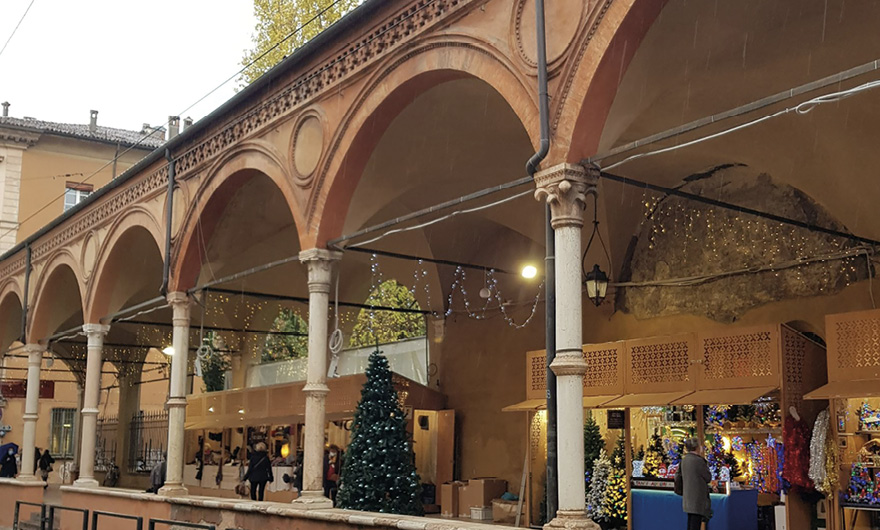
We don’t know for sure if Scipione del Ferro took part in these challenges under this specific portico, but it’s likely that similar places hosted discussions and debates among students, teachers, and citizens interested in knowledge. As testimony to the link between this place and del Ferro, there is a commemorative plaque under the portico near the entrance to the basilica. The plaque celebrates del Ferro’s scientific contribution and calls attention to the cultural role of the space over the centuries. This is not just a formal tribute, but a tangible sign that invites passers-by to discover Bolgna’s many layers of meaning.
Walking under the Portico dei Servi, among the lights of the fair and hundreds of other people, means seeing a place in which business, religion, and knowledge have intermingled for centuries.
Christmas under the Portico dei Servi is therefore also an opportunity to discover the profound value of a place that has always represented the encounter of different aspects of city life: sacred, commercial, and cultural. Among the lights of Christmas decorations and the bustling of the Fair of Santa Lucia, the portico becomes a lively and vibrant space, where history and tradition mix with the daily life of people who, year after year, join to celebrate together.
The plaque commemorating Scipione del Ferro, with his passion for knowledge and mathematics, is an integral part of this scenario, suggesting that the fair is not only a moment of outward celebration, but also an invitation to foster curiosity, discussion, and study – values that have helped make Bologna a city of culture and science.
 Italiano



.png "Aderente alla Consulta tra le Antiche Istituzioni Bolognesi")