MAR, the Ravenna Art Museum, is located in the former monastery of Santa Maria in Porto, built next to the Basilica in the early 16th century.
The building has a splendid 16th-century cloister and an elegant loggia (called Loggetta Lombardesca because it was built by Campionese and Lombard Masters) facing the public gardens.
The original structure, which had undergone numerous changes in use since the age of Napoleonic suppression, was restored in the early 1970s. There remains the cloister with its Renaissance proportions, the layout of spaces, and the elegant 5-arched loggia, which has become the symbol of the entire complex.
Since 2002, the Ravenna Art Museum, founded that year as an Institution of the City of Ravenna, has been housed in the Loggetta Lombardesca.
The Museum conserves and safeguards a large heritage: the Modern and Contemporary Mosaics Collection, the collection of works from the 14th century to contemporary art, and the Plaster Cast Gallery of the Academy of Fine Arts.

In addition to safeguarding and enhancing its heritage, MAR organizes temporary shows that aim to promote the research and experimentation of artistic media, creating bridges among generations, cultures, and sensibilities.
MAR has chosen our Institute with the intention of making the Museum’s rich artistic heritage enjoyable to the greatest possible extent.
Our Institute’s activities are conducted on two levels: the first involves targeted and thorough training of all personnel; the second is the creation of aids to ensure understanding of the Museum’s space and enjoyment of the collection’s most iconic works.
The training process is especially important, and consists of the following steps:
- training devoted to receiving groups of visually-impaired visitors;
- training devoted to making digital products accessible (posts on social media, production of accessible digital documents, etc.);
- specific training devoted to creating inclusive laboratories, given the increasing importance of this activity for the public’s enjoyment of museums;
- other meetings to analyze what it means to make a museum enjoyable in general.
With the aim of making the Museum enjoyable by everyone, we involved some important organizations: the Gualandi Foundation (in relation to hearing impairment), and the Accaparlante cooperative (regarding the reception of people with cognitive and motor impairment, and training on how to create simplified texts.)
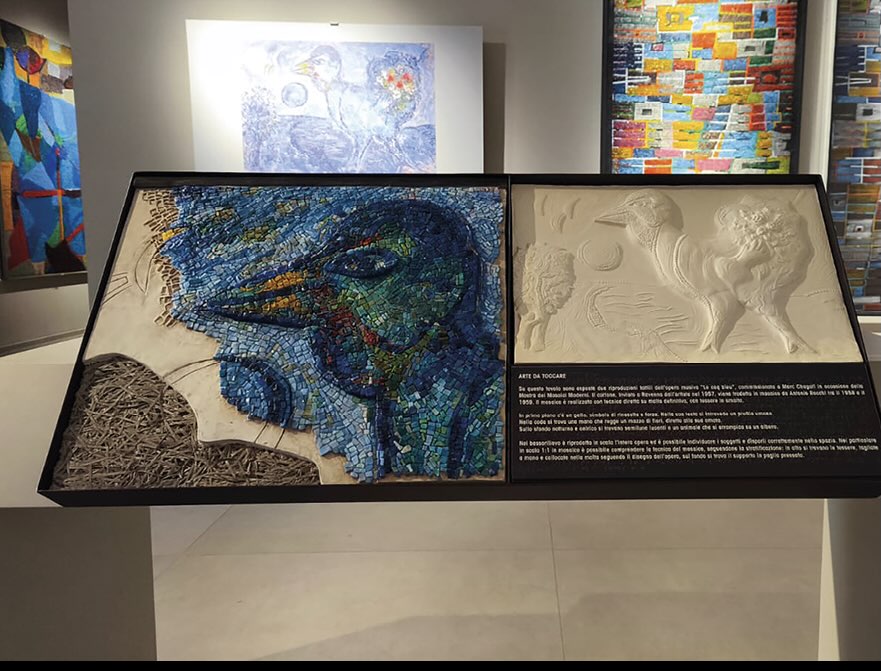
Various works have been created, such as a perspective bas relief of Marc Chagall’s “le Coq Blue,” and a Minolta oven was used to reproduce (among other things) Georges Mathieu’s “Omaggio a Odoacre.”
In addition, several tactile maps were created: an external one representing the Museum’s location in the city center, indicating streets and monuments, and other internal maps with layouts of the Museum’s floors, indicating the spaces used to exhibit works as well as all public services (bathrooms, cafeteria, bookshop, ticket counter, etc.).
And, along with reproductions of works and maps, we created (in Braille and in enlarged letters) various plates that describe the Museum’s mosaics.
In conclusion, this important work represented a major commitment by our Institute and by the Ravenna Art Museum, and most of all was a big step toward providing better and more inclusive services to everyone.
 Italiano

.png "Aderente alla Consulta tra le Antiche Istituzioni Bolognesi")