Tim Hetherington was a war photographer and documentarian, always on the front line, because in order to give life to his photos he wanted to be “where there no rules on how to act, where you’re facing extreme situations,” where (I add) humanity can take the most unexpected forms. His direct experience of war scenes brought him to an early death in 2011, while working in Libya during the first civil war.
On one of his missions, he went to the Milton Margai School for the Blind in Freetown, Sierra Leone, where he met and photographed the students, some of whom were blinded by guerrillas in the Revolutionary United Front (RUF).
The civil war, which began in 1991, was as usual determined to destroy and massacre the civilian population: in particular, even the normally apathetic western world was shocked by the amputations and rapes of villagers committed by RUF guerrillas. As opposed to the mutilations of limbs, there is no proof - merely some testimony - that amputations systematically called for the blinding of victims.
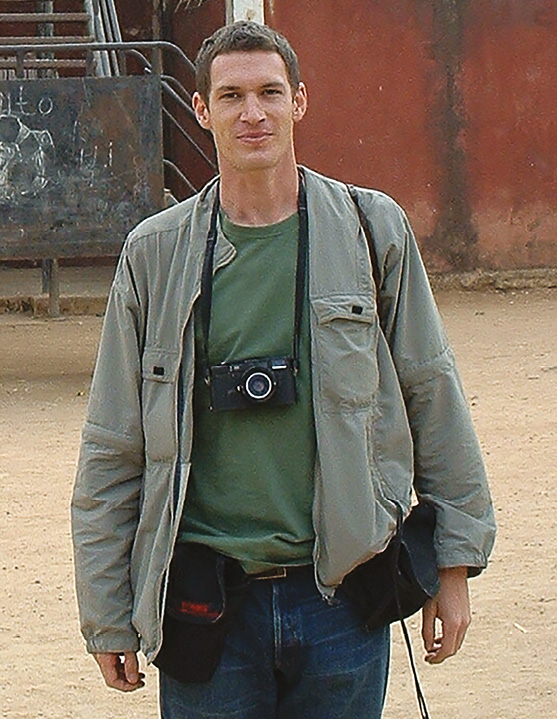
Tim Hetherington was at the school for five years, from 1999 to 2003, in order to witness this situation first-hand and photograph what was taking place, made even more dramatic by the war. Paradoxically, his photos don’t emphasize the desperation, cruelty, lack of humanity – just the opposite, demonstrating that even in horrendous situations people are capable of preserving their humanity.
The images that he left us portray moments of life in the school, with students in classrooms, halls, courtyard. One gets the impression that the photos were not taken randomly, but that he waited patiently for that precise moment, perhaps walking and talking with the students, who called him Uncle Tim, an everyday presence among them.
One black&white photo shows a boy about 8 or 9 years old, standing and looking at us. Two-thirds of the background is dark, the rest softly lighted. The boy, in the lighted part, is doing something, carrying a notebook in his arms, but stops and seems to be looking at us. His thick lips are slightly parted, his eyes half closed, his left eye milky. But what gives this image substance are the different size rectangles of light striking the various elements of the photo. You realize that the sunlight is passing through a cement grating facing a corridor where the child has stopped. The dark area in the background is the interior of the classroom.
The rays of light strike everything: the boy’s face and lips, the walls of the corridor, and even in the dark classroom, where they draw tiny windows in which we realize that – beyond the darkness – there are people and things in that room.
In another photo, a girl with half-closed eyes is looking in the distance. She’s in a lighted room. Her white clothes contrast with the black wall, while her head contrasts with the light-colored upper part of the wall. She’s pretty and proud, looking elsewhere, not at us.
For Tim, his experience with the blind students of the Milton Margai School was both professional and very human. Here he acquired intimate knowledge of the consequences of war, which he would encounter once again in Afghanistan, Sudan, and, ultimately, in Libya.
 Italiano



.png "Aderente alla Consulta tra le Antiche Istituzioni Bolognesi")