Aesthetic education has an essential function for cognitive and intellectual life, especially for people with visual and neurological disorders. In visually-impaired and blind people, sensory stimulation, understood as an integrated system of visual, tactile, linguistic, and auditory stimulations, involves a reorganization of perception, cognition, and assignment of meaning to reality and of its possible identifiable and recognizable representations. Aesthetic education, a cognitive gymnasium, focuses not only on the purely stylistic qualities of art forms – while still considering their historical significance and cultural values – and concentrates above all on reorganizing visual thought, on searching for directed gestaltic alignment in case of visual and neurological damage. To gradually recover linguistic and perceptive skills, for purposes of ensuring recognition of familiar shapes and promoting even partial recovery of personal autonomies, integrated visual-tactile explorations are a necessary tool.
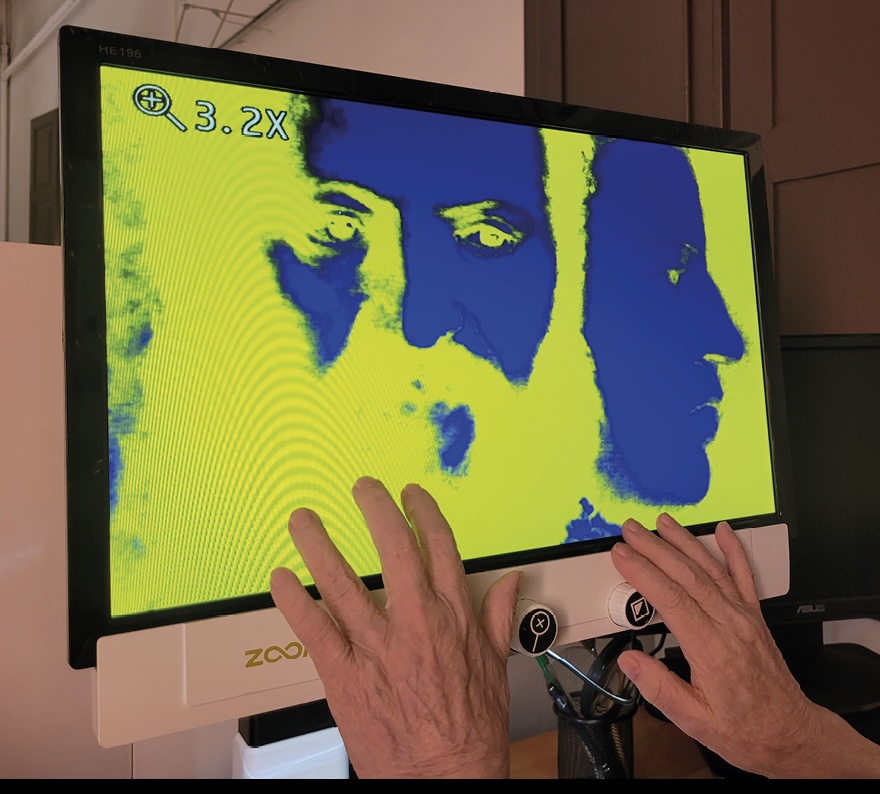
Normally, a visual-tactile education that involves exercises of physical perception of recognized shapes focuses on vision of the entirety and on details of contrasting images, and is performed with the use of enlargement aids if necessary. On the other hand, tactile education complementary to visual education consists of exercises that involve the fine tactility of the visually-impaired person, especially if suffering from degenerative visual disorders. After a stroke or brain bleeds, there may be specific visual-perceptive disturbances such as hemianopsia (loss of vision in part of the visual field), or agnosia prosopagnosia (inability to recognize objects, faces, or other sensory stimuli). In these cases, it is urgent to commence perceptive reorganization by stimulating the senses directly involved in recovering physical knowledge of reality, but also by working on the recovery of short- and long-term memory by means of repeated exercises of oral description of familiar images through tactile explorations of compositions to be given concrete significance, at times limited, at times more general.
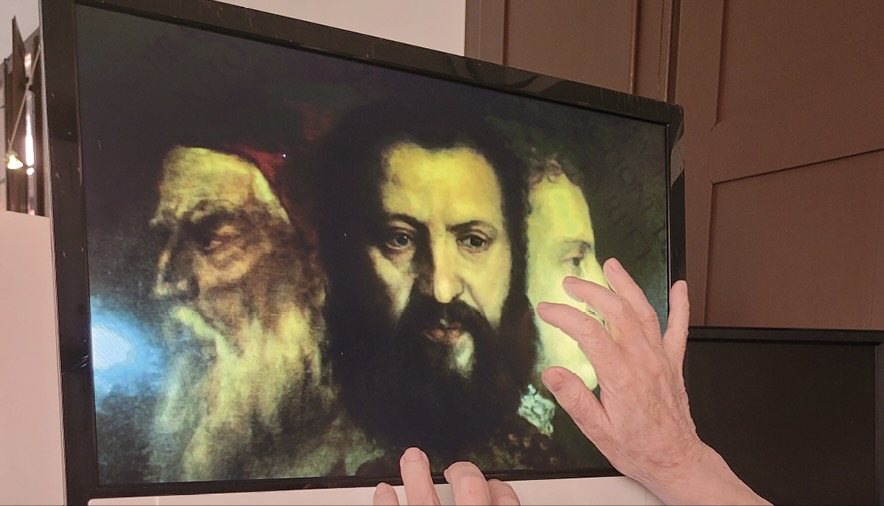
The repetition of exercises in tactile perception, eye-hand coordination, and speech articulation help restructure visual thought that does not depend on visual-tactile and sensory-motor ability, and must be conducted by a team. Therefore, the Anteros Tactile Museum works constantly with the Visual Impairment Center and with the Francesco Cavazza Institute’s Educational Consulting Service with the aim of guaranteeing patients and users a sufficient number of sessions to promote possible improvements which, for both statistical and qualitative assessment, require clinical monitoring and checks, based in all cases, with regard to the pedagogical method of the sessions, within and not beyond the interdisciplinary didactic context, on precise sensory stimulations rather than on a targeted integration of residual senses, as a result of a re-education of morphological and semantic knowledge of real-life experience. For this purpose, especially in cases of sharply reduced visual acuity or visual field, the proprioceptive and kinesthetic experience (conducted with suitable care and delicacy in elderly individuals who may be emotionally exhausted) reawakens reactiveness and awareness of body sensitivity. To keep a person with sensory deficits from incurring experiential and cognitive stasis, it is essential to constantly do exercises for perceptive and logical ability, and in order to guarantee laboratories for visual-tactile and sensory-motor education, it is indispensable to work as a team. Therefore, the Anteros Tactile Museum works constantly with the Visual Impairment Center and with the Francesco Cavazza Institute’s Educational Consulting Service with the aim of guaranteeing patients and users a sufficient number of sessions to promote possible improvements which, for both statistical and qualitative assessment, require clinical monitoring and checks, based in all cases, with regard to the pedagogical method of the sessions, within and not beyond the interdisciplinary didactic context.
 Italiano



.png "Aderente alla Consulta tra le Antiche Istituzioni Bolognesi")