Andrea Camilleri’s surprising testimony throws open the interpretation of blindness as the exclusion of a sense which, nevertheless, intensifies perception, focus, precise hearing, and inner orientation. Due to incurable glaucoma, Camilleri lost his sight, and with it his beloved reading, watching the body of words form on the page with the scent of ink. It was precisely due to his blindness that he created the monolog “Conversation about Tiresias,” which he performed from stage to stage, giving voice to the ancient myth. On the other hand, John Martin Hull’s experience offers a different contribution, perhaps even more powerful for both the sighted and the blind, narrating every daily, existential, practical, sociological, and spiritual aspect. On the one hand, it accompanies the sighted toward greater visual awareness, and on the other it offers methods and sensibilities to be close to blind people without being excessively protective. But, in addition, it instills the blind with energies that give meaning to their life, always and everywhere, stimulating it with infinite incentives drawn from his immensely human, intellectual, religious, personal realm. Hull describes his journey into blindness, with agonizing fears, mental blocks, precise events, episodes, relational dynamics that create misunderstandings, embarrassments, never stooping to pathetic sentimentality, but with a style that also employs irony as he depicts its dramatic nature. He combines energy and steadfastness, unleashing understandable but lethal victimizations. Beyond this, I think his most extraordinary quality is his new interpretation of the Bible, in which, with extreme precision and equal passion, he treats the passages in which blindness and visual impairment are protagonists.
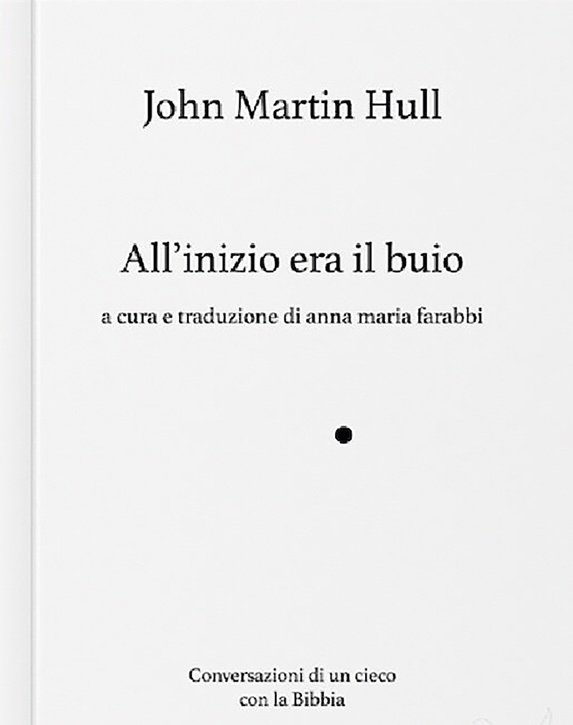
He historically contextualizes the events described and identifies the roots of cultural and social prejudices that still persist, such as the attribution of the disorder to God, with subsequent self-blame, and the difficulty (if not impossibility) of being a priest. Hull asserts that the Bible was written by sighted people, who unknowingly projected a perspective of disability so powerful that it remains to this day, considering the western world in its dichotomic setting in which light is associated with purity, divinity, and revelation, whereas darkness is deemed a symbol of gloom, sin, and chaos. I devoted many years to the study of John Martin Hull’s works, interviewing him in Notes on Blindness (Terra d’Ulivi, 2021) and translating him in In the Beginning there was Darkness: A Blind Person's Conversations with the Bible (Al3vie, 2022). These, along with A gift to the Child (Adelphi, 1990), are the only Italian translations of his works. Each makes for fascinating reading, simultaneously exploring aspects of theology, psychology, and sociology, leading us to question our customary or – for the blind – defeatist behavior.
John Martin Hull (1935 – 2015) was born in Australia and worked in Birmingham (UK) as a Professor of Theology and Religious Education. In 2016, the documentary film Notes on Blindness by Peter Middleton and James Spinney, won first prize at the British Independent Film Awards.
 Italiano



.png "Aderente alla Consulta tra le Antiche Istituzioni Bolognesi")