”Oops… I did it again!,” sang Britney Spears, and we did it again, too! In July 2025, we returned to Cavalese in Trentino, for the second year of the “I sensi della montagna” recreational and skill-building summer camp.
Two one-week stays, designed by the Francesco Cavazza Institute’s Educational Consulting Service in collaboration with I.Ri.Fo.R. Emilia Romagna, involved 28 children and teens with visual disorders (some with mild multiple disorders). The first week was for children and teens 8-14 years old, while the second was for teens 14-19 years old
You might think that coming back to the same place (and even the same hotel) as last year would be boring and repetitive. Not at all! And here’s why:
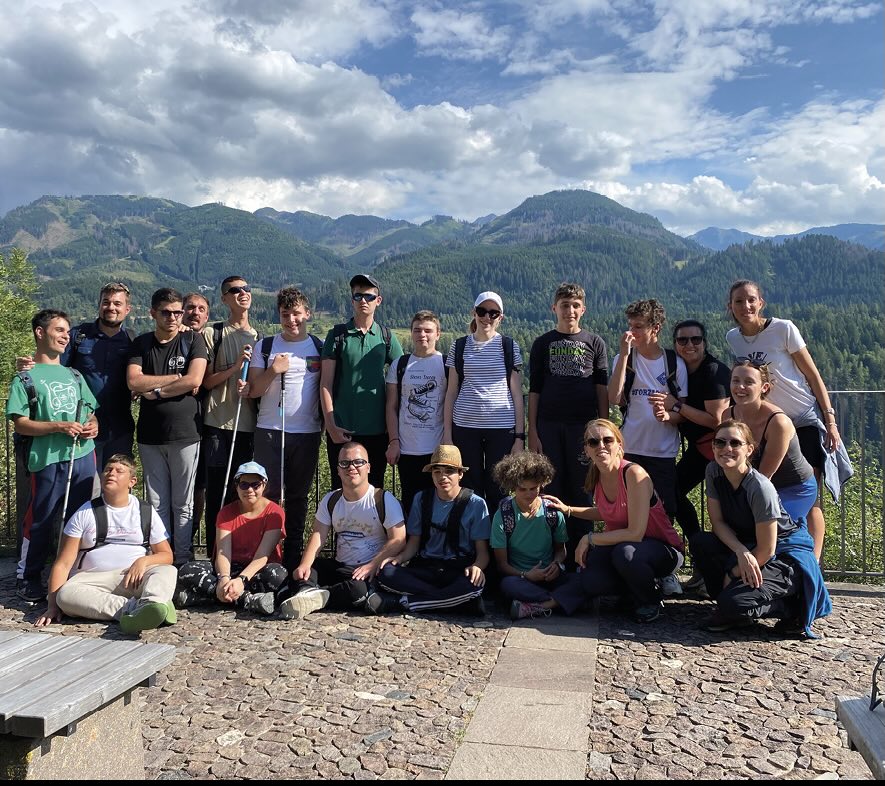
The children and teens weren’t the same as last year. There are new ones every year, so the groups are renewed, creating new dynamics and new friendships. Parents don’t participate in the camps, so for these young people the camps provide a precious opportunity for growth, separation, and identification, a stimulating time to strengthen personal autonomies and promote discussion and socialization among peers.
Every year, the camp tries to offer them new experiences and, at the same time, past activities or laboratories calibrated to their specific needs.
For example: one new activity this year was a day of approach to a horse, which was very enjoyable; we also repeated the day in a swimming pool (always lots of fun!) and, of course, hikes up the mountains (with gondola life and chair lift). This year we had the privilege to be helped and accompanied by “Fiemme Fassa Sport Inclusivo,” a local association that promotes inclusion of the disabled by means of sports and cultural activities. “F.F. Sport Inclusivo” involved not only adult volunteers, but also about ten local children and teens who became friends with ours and walked at their side the entire day (helping them if necessary). It was a wonderful example of inclusion (and made our long walk less tiring).
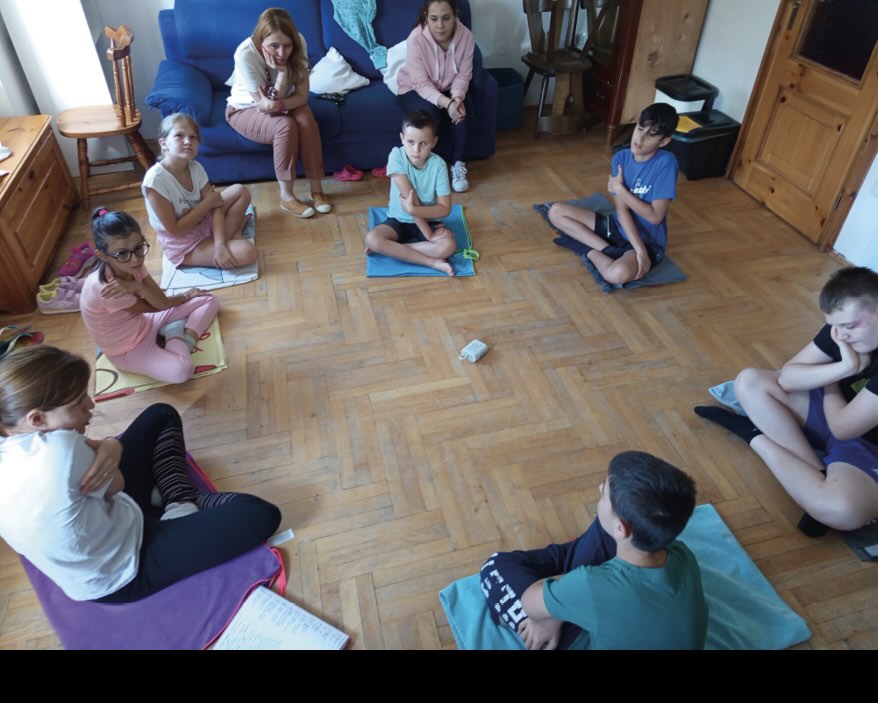
As they do every year, our expert teachers and orientation/mobility instructors involved the kids in laboratories and activities to strengthen their abilities and autonomies (how to move, use their cane, autonomies at the table and in managing their things, etc.).
But the activities that made the deepest impression on me, perhaps due to professional deformation, were the ones that focused not on doing but on feeling. Like the Yoga-Pilates laboratory conducted by Martina Belvisi, in which feeling takes root in the body and awareness is brought to non-verbal communication expressed through the body. Or, like the Book Club evenings, devoted to reading a children’s book out loud, which captivated and thrilled all of the participants, proving that it’s still possible to “detox” from digital devices and reconnect with each other, remaining silent, listening, searching, with only the power of a story holding us together.
We strongly believe that for young people with visual impairment, growing means more than learning to do things by themselves, but, most of all, being more aware of what they feel, of what they want, and of who they are.
 Italiano

.png "Aderente alla Consulta tra le Antiche Istituzioni Bolognesi")