Villa Spada, overlooking the first slopes of the Casaglia hills, has witnessed over two centuries of Bologna’s urban and social history. Built in the 18th century by the Zambeccari family, the villa was initially their country residence, surrounded by a geometric garden designed according to current fashion, with terraces, straight paths, and panoramic views of the city.
Its ownership changed several times over the years. From the 19th to 20th century, it was converted into a military headquarters, then a museum, and lastly a civic space. Although the garden was partially conserved, it slowly deteriorated: disconnected paths, damaged statues, untended greenery. Although the original structure was still visible, there was a lengthy and precarious equilibrium between historical memory and daily use.
In 2023, Villa Spada’s garden was completely renewed, with funds provided by the Piano Nazionale di Ripresa e Resilienza. The project, promoted by the City of Bologna, had a dual goal: preserve the historical layout and make the area accessible, sustainable, and open to the public.
.png "Villa Spada - photo by Evelina Ribarova")
The renewal concerned all of the garden’s main elements. The neoclassic small temple, symbol of the villa, was restored along with the statues and the main fountain. The previously damaged paths were remade with long-lasting materials that were visually compatible with the site. A new-generation exposed aggregate concrete was chosen, ensuring continuity with the past as well as greater strength and lower environmental impact due to the use of local components.
In addition to the architectural elements, a new rainwater collection system was installed to improve drainage and prevent erosion (frequent in sloping gardens). The lighting system was completely renewed and the paths were upgraded to ensure access to people with disabilities, thereby eliminating an issue that had limited the area’s use for years.
While preserving the original layout, the project changed how the garden could be used. It wasn’t a commemorative restoration, but rather a functional transformation that allowed the garden to once again play an active role in the city’s network of public spaces.
Villa Spada is now reconciled with its history: the structure of the 18th-century garden has been recovered and made compatible with current needs, without any exaggeration or forced reconstruction. The result is a space that preserves the cultural value of the past but is appropriate for modern use, with adequate infrastructures, safe paths, and a balance between protection and access.
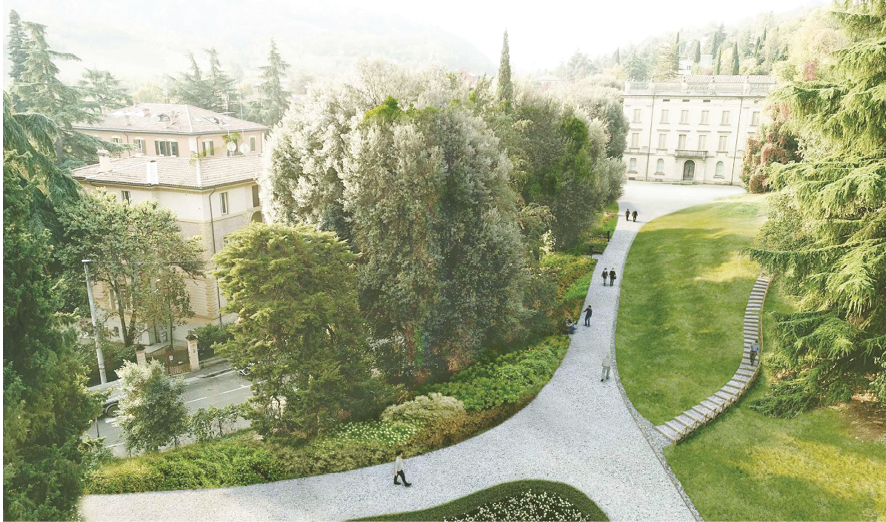
The garden’s reopening in December 2023 was an important step in the enhancement of the city’s historical green areas. In an urban context marked by transformation, the renewal of Villa Spada proves that conservation, accessibility, and sustainability can be merged without sacrificing the location’s identity.
 Italiano
.jpg "Vedere Oltre - Cover")



.png "Aderente alla Consulta tra le Antiche Istituzioni Bolognesi")