The right to an independent life is based on the relationship between personal autonomy and well-being through the affirmation of one’s right to choose.
This applies to everyone, regardless of one’s state of health or functional limitations, but is even more important for people with disabilities because it influences their active participation in their community. Over the last few years, the debate over personal autonomy in the urban environment has been the subject of research and testing in many interdisciplinary fields.
The use of the city is a universal right and leads to multiple investigations, stimulated over time by the progressive paradigm shift linked to accessibility and disability as well as autonomy and independence in urban spaces, a subject that has fueled the debate globally for several decades. The 2006 United Nations Convention on the Rights of Persons with Disabilities makes it clear that “an Accessible City is one with a public program, services, and spaces usable by all types of people” in the broadest possible sense, without the need for special adaptations or modifications, without excluding, where necessary, means of assistance for specific groups of people with disabilities. Global organizations such as the World Bank and the World Health Organization (WHO) estimate that one billion people with disabilities (2011 data) now face significant barriers to inclusion in many critical sectors (mobility, work, education) or simply to being socially or politically involved in daily life.
According to ISTAT (the Italian Institute of Statistics), in 2013 the City of Bologna had 21,200 persons with disabilities, representing 5.8% of the population over 6 years of age. Women were 7.5% of the total, men 3.9%, plus 800 to 1000 university students.
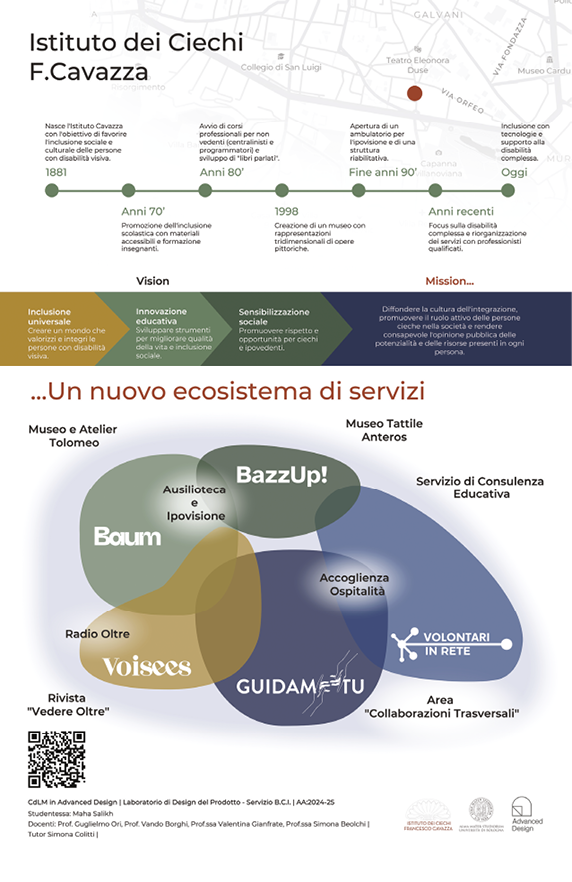
In 2018, this estimate increased by 100, bringing the total number of persons with disabilities to 21,300. Based on these data, from September 2024 to January 2025, the students in the Master’s Degree Courses in Advanced Design of Services within the Product-Service Design Laboratory analyzed the conditions that limit personal autonomy, based on a multidisciplinary approach combining tools for design, analysis, and data visualization with sociological research and with community engagement and participation strategies. By means of direct contact with the Francesco Cavazza Institute for the Blind in Bologna, the laboratory’s objective was to support the process for creation of the new Center for the Autonomy, to satisfy the need to conceive and co-design new service planning processes to improve the quality and inclusivity of the urban environment, and to raise awareness of matters linked to various disabilities by means of information and communication initiatives. In a series of 3 roundtables with the Institute’s users and staff, the laboratory co-designed, prototyped, and tested methods to upgrade services for education, entry in the job market, mobility, and social and cultural life, by means of closer connection to the city, to enhance an internal/external relationship in an innovative design process.
.png "System map of proposed projects")
Beyond the design results, presented at an exhibit inaugurated in the Cavazza Institute on 6 February, the incredible human experience that generated the direct collaboration with the Institute’s users and the professionals represents a very important learning process for young students of design, training them to design with awareness of the social and cultural consequences of their actions.
 Italiano
.jpg "Vedere Oltre - Cover")



.png "Aderente alla Consulta tra le Antiche Istituzioni Bolognesi")