Sunglasses are often considered just a summer accessory that only help reduce annoying light. Actually, they should be worn to protect the eyes, at every age. Over time, ultraviolet (UV) rays can damage eye structures, contributing to the development of serious problems.
Just as we protect the skin with sun cream, the eyes need a barrier against UV rays, which are present not only in the summer or on sunny days, but also when the sky is cloudy. Excessive exposure to UV rays may cause progressive harm, especially in highly-exposed individuals, such as people who spend a lot of time outdoors or ones who suffer from some eye diseases. A common error is thinking that all eyeglasses are the same, and that you just have to wear dark lenses to be protected. But what really counts is not that the lens is dark, but that it actually filters UV rays and, if necessary, the higher-energy components of the spectrum, such as blue and violet light. A very dark lens that doesn’t filter can even be harmful: the pupil dilates due to the perceived lower light level, and this can expose the crystal and retina to higher exposure to harmful rays. It is important to choose certified eyeglasses that specify their protective properties. In the presence of some disorders, an ophthalmologist may prescribe the use of photoselective filters. How do these lenses differ from normal sunglasses?
Normal sunglasses lower the intensity of perceived light and the annoyance of glare, protecting against UV rays. Photoselective filters offer a wider range of protection, completely blocking some wavelengths of light – especially those most harmful to the retina – while allowing frequencies useful for vision to pass through. This type of lense is prescribed especially in the presence of retinal disorders such as, for example, senile macular degeneration, retinitis pigmentosa, and whenever the ophthalmologist deems necessary.
In addition to reducing glare, photoselective filters can improve the perception of contrasts, thereby improving the quality of sight both indoors and outdoors. As a result, these lenses are often used by the visually impaired in daily activities, such as with electronic devices and for sustainable mobility.
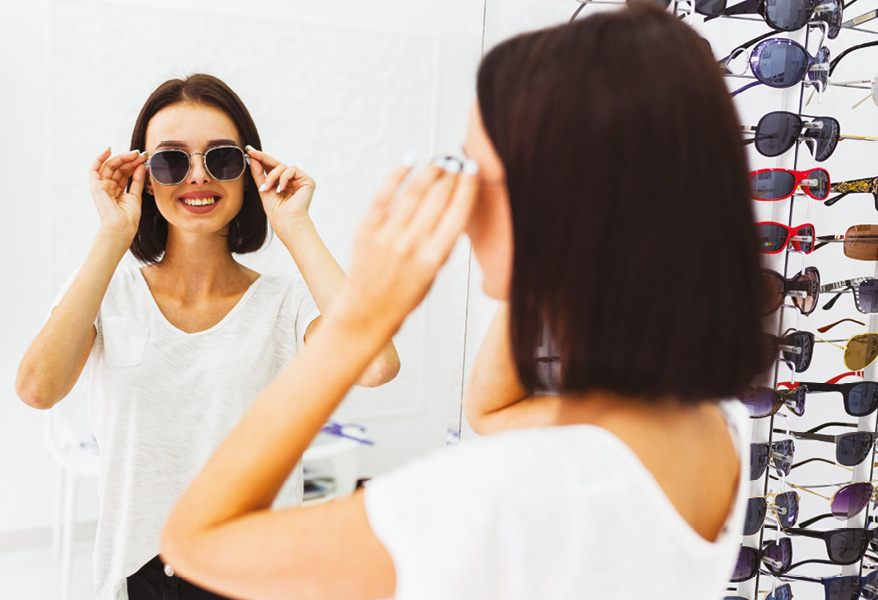
Therefore, wearing sunglasses whenever you’re exposed to strong light is a simple but important form of prevention for both adults and children, safeguarding future visual health.
The Technology Help Center at the Francesco Cavazza Institute for the Blind provides consulting services for aids for the blind and visually impaired, information on the properties of lenses, their availability, and intended use. The portal www.invat.info in the Devices & Aids Register can be consulted for technical information on availability and intended use. In the presence of eye disorders or specific risk factors, it is always advisable to consult with your ophthalmologist.
Personal services
Evaluation of aids and counselling for the visually impaired.
Ausilioteca (Technology Help Centre)
A place to discover and work with aids to increase personal autonomy.
Limitless
This project, for people over 65, teaches how to use computer tools to make daily life easier.
Educational counselling
Provides support to students, families, and teachers for training needs and inclusive education.
For information:
+39 051.33.20.90
ausilioteca@cavazza.it
ipovisione@cavazza.it - sce@cavazza.it
 Italiano
.jpg "Vedere Oltre - Cover")



.png "Aderente alla Consulta tra le Antiche Istituzioni Bolognesi")