Picking up from my previous article and providing elements to understand the method I’ll present in the third, I now define the Body Schema:
The dynamic set of information on posture, kinetics, and timing that helps us act in the real world; the awareness of a well-structured body schema, linked with the possession of many motor schemas and with discriminating sensory-perceptive structures to allow good motor coordination in the environment.
The literature tells us that every situation and object other than the person him/herself, is defined as Environment: everything outside of me is Environment and I live immersed in it. Especially in cases of congenital blindness, it is essential that infants be curious, interested in the world and in understanding how their body interacts with the Environment.
Parents and teachers must be careful to propose different stimuli linked to the other senses.
This is the important work of early intervention centers, which stimulate interest in the world and the pleasure and gratification of interaction with what “isn’t me.”
Local tiflo-didactic educational and visual rehabilitation centers can participate with information, ideas, and new stimuli as the child grows.
Blindness or visual impairment impedes learning through visual imitation, and therefore tactile, physical, sound, and haptic channels will be preferred.
Non-locomotor movement patterns are learned by working with the body on proprioception, but it is also necessary to work on auditory discrimination, on echolocation, on the use of verbal information and modulated signal calls for dynamic situations. The skills involved in localizing and discriminating sound information can lead me to walk in a direction, parallel or perpendicular to that sound, etc.
A sensory tactile mat is used to train the hand as well as the feet, so I can have quadruped, erect postures, and move in an assisted perceived space. I’ll start by crawling and rolling, pushing and pulling, and finally running and jumping using the references on the floor.
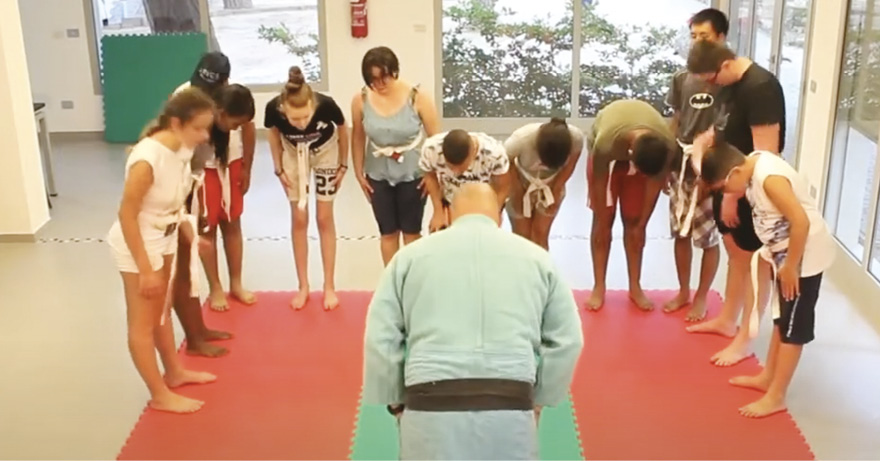
We supply materials with various degrees of thickness or firmness to promote handling: soft balls, textured objects, etc. We use sounds to indicate directions, distances, or objectives, bells or musical instruments, etc. We stimulate body awareness through movement and guided physical contact: movements together with the child, physically guiding hands, feet, or body.
With blind children and their classes in the gym, we create tactile paths with different surfaces; use obstacles that are easily perceptible to touch or sound; add exercises with sound guides; use tactile signs on the floor to indicate optimum localizations and movements; propose games with sound balls or objects with easy-to-grasp textures. The activities should take place in a playful and imaginary environment, so that the children are always stimulated to participate as well as gratified by accomplishing the steps proposed.
Without a doubt, an exciting experience.
Measurable as well.
As we’ll see in the next issue.
 Italiano
.jpg "Vedere Oltre - Cover")



.png "Aderente alla Consulta tra le Antiche Istituzioni Bolognesi")