If even the pros miss penalty kicks, it’s hard to imagine how a blind player can score a goal. And yet, contrary to all of our prejudices, blind people can do every sport – including soccer – as shown in Stefano Urbanetti’s beautiful film “Quattro Quinti.” On the ASDD Roma 2000 team, the film’s protagonist, four players are blind and only the goalie can see. With passion and sensitivity, Urbanetti shows us that sports can truly unite, eliminating barriers and making everyone an active member of the team. With audio description, subtitles, and lively sound, the docufilm (distributed by Rai Cinema, and candidate in its category for the 2024 David di Donatello) has been seen in many festivals, always to great acclaim – so much so that it won the 2024 Culture Accessibility Prize.
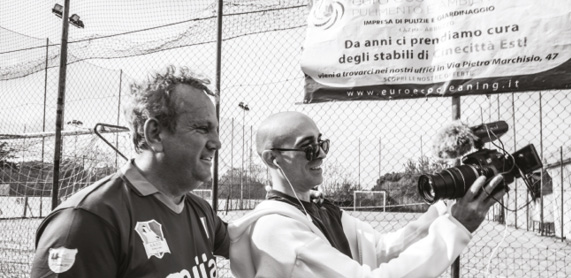
What led you to tell this story?
This project let me combine my two great loves – football and cinema – in addition to music, which plays an important role in the film. It all derives from a meeting with Jacopo Lilli, one of the leads. What he told me, from the very start of our first conversation, was just incredible, and I remember perceiving almost a calling that naturally led me to make “Quattro Quinti,” which, with Jacopo, I immediately started to conceive. A director is always on the lookout for something that can excite the public, but in this case I think it goes beyond that, because it’s a film that created a catharsis in me, it changed my life, not just professionally, but as a human being. It’s a story that I urgently needed to tell, to give visibility to this surprising sports reality, overflowing with pure and uncontaminated values which, in a society ruled by image and appearance, take on an even deeper meaning. I’m proud of the result, especially for the team staff and the players with whom I created a strong emotional bond. It’s a world made of 4 of the 5 senses, in which I entered very cautiously, and I’ll always thank my leads, who immediately trusted me and guided me step after step. There are many realities than we can’t even begin to imagine, and the ones that are the most unknown and unexplored are the most fascinating.
Can art promote inclusion?
Art, in this case cinema, is an excellent means for transmitting messages of inclusivity. And sports, which in a way is a metaphor for life, as in this case in which the actors have a visual impairment that they overcome by playing soccer, is perhaps even more so. The most important aspect is precisely the message of inclusivity, which these wonderful players transmit so naturally. I expressed this concept when they awarded us the XIII Sorriso Award at the Rome Festival, a very important award because it’s given to the best Italian film dealing with social themes. In their interviews, the players explain that sight is a paradoxically unwieldy sense that influences and corrupts the other four, which for them are much sharper. This experience also taught me (and I thank Laura Raffaeli, chair of the Blindsight Project, for her precious help) that every director and producer has the legal – and especially moral – duty to make every film accessible. This too is an important and generous form of inclusivity.
You as the director has your view. What is the view of your actors?
I love to get excited and to excite others with my films. In this case, it’s a worthy story that I experienced first-hand and narrated, and I think the film is in some way groundbreaking: the protagonists who live in the dark bring an enormous light that illuminates, almost blinds, and fills with joy. Their gaze can be synthesized in a precious scene, which for me is emblematic: Jacopo describes the emotion of a goal, one by a person with 4 senses who scores against a sighted goalie. This demonstrates the extent to which these disparities are actually very subtle, ephemeral, and that a person’s limits are just a mental block, apparent barriers that can be destroyed and through which one can go beyond.
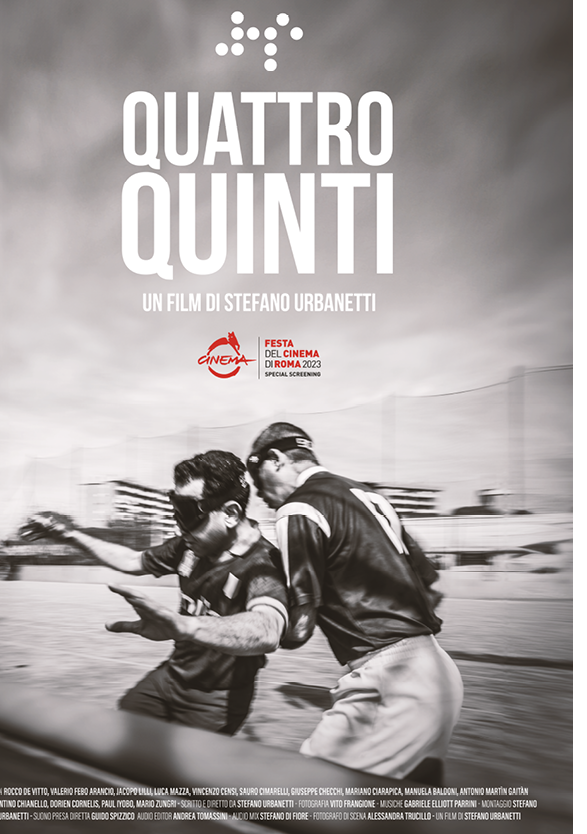
Plans for the future?
I have lots of them, especially three biographical TV series, I have the screenplays ready, and they have already received government approval. I’m at an advanced stage of work on a docufilm on the life and career of director Sergio Citti, whom I had the honor of knowing and with whom I worked on the writing of three screenplays. I’ve already interviewed many of Citti’s actors, friends, and co-workers, who told me stories of his artistic and human background and of his great storytelling abilities, describing life in the Roman suburbs, his encounter with Pasolini, and of course his most iconic films, such as "Beach House" and "Il minestrone."
 Italiano
.jpg "Vedere Oltre - Cover")



.png "Aderente alla Consulta tra le Antiche Istituzioni Bolognesi")