I have devoted myself to tactile books for almost 25 years, in addition to designing projects to develop and enhance Sensory Education. Most of all, I’m interested in fostering relationships provided by touch. I began with the Manifesto of Tactilism, conducted a thorough research on “tactile harmonies,” and designed a series of experiences in the dark for a variety of people and in various contexts.
My studies of “tactile harmonies” is also presented in two artist books created with Marcella Basso. The first, Nodi (Knots) contains my haiku: il pesce nuota / la libertà del mare / strappa la rete (the fish swims / the sea’s freedom / tears the net). I believe that attention to and development of touch promote an awareness of sensory dialog that allows people to face difficult situations by having faith in their abilities. Marcella Basso even embroidered the text in Braille. The other book, AP…PUNTI (Notes) has pages die-cut by hand and contains, in addition to numbers (legible by means of the progressive increase in holes), two haiku. The first welcomes the reader and invites them to pause on the “sign”: tatto esplora / carezzevole mano / conta il segno (touch explores / caressing hand / the sign counts. The second stimulates thought on the journey to which numbers inevitably lead:
viaggio prosegue / due è più di uno / ma uno conta (journey continues / two is more than one / but one counts).
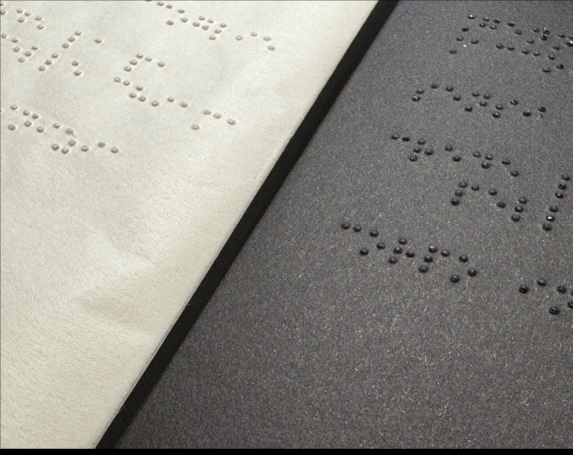
Marrying the power of metaphor, the two haiku offer a wider vision: the numbers lead to active participation by means of the experiences and relations that the individual receives based on a “sensitive” reading of the sign that these numbers leave internally and externally.
Therefore, my research led me to analyze touch through the relations that develop among people during these experiences in the dark and from those that develop during the handling of tactile books, by means of warm and stimulating mediation that leave space for each person as well as interaction within the group.
The Tactile Calendar plays an essential role in my project. I wrote 12 poems, imagining an abundant synesthetic space that could help develop dialog among the visually-impaired, a continuous and careful reflection on touch. The Calendar’s verses “play” touch in all directions: they’re already “tactile” words, sensitive and welcoming, that trace every synesthetic aspect of the sensory experience. They’re the expression of care: they feel the skin that discovers and vibrates; the flow of life; they give hearing the opportunity to move the gaze, to be aware of what changes in space; they know the indispensable value of smell for memory; they believe in relations and in the power of the embrace, which permeates all. The poems were written so that the Calendar could have a circular structure (January and December dovetail). As I wrote, I felt the importance of touch for everyone; tried to express its complexity and potentials; emphasized that awareness is essential for its enjoyment, for the possibility of fruitful dialog with the other senses. I intentionally used very few articles in order to safeguard the essence of touch, the courage of its fullness and emptiness that the apparent silence of touch discovers.
I thank Pier Michele Borra and Fernando Torrente for having accepted my offer to present the Tactile Calendar at the Francesco Cavazza Institute for the Blind on the occasion of the International Day of Persons with Disabilities (December 3, 2025) and, most of all, Loretta Secchi and Fabio Fornasari, who immediately approved my project with great sensitivity to its human, cultural, and educational aspects.
Loretta Secchi wrote a critical essay on the Tactile Calendar, offering much food for thought, and Fabio Fornasari created a tactile artist book that enhances the Braille code by means of skillful removal.
 Italiano
.jpg "Vedere Oltre - Miniatura di copertina")


.png "Aderente alla Consulta tra le Antiche Istituzioni Bolognesi")