This year marks the centenary of the birth of Wolfango Peretti Poggi, an artist who excelled both technically and content-wise, on a solitary path, just like the wolf to which his name refers. Gifted in drawing and painting from a very early age, he had his first lessons in the language of signs and color from his uncle, a painter. After graduating from Galvani High School in Bologna, and since his parents wanted him to become a doctor or a lawyer, he went to medical school, where his studies in anatomy would later be applied to the figurative arts. He subsequently interrupted his studies and devoted himself entirely to painting. Wolfango’s greatness as a man and artist (his signature included the name of his wife Chiara) lies in his comprehensive investigation of art, including applied art, with intelligence and profound thought. He was also a free and independent voice in contemporary art, a refined illustrator, an expressive and incisive molder: his memorable Nativity Scene has no equal anywhere in the world. For me, Wolfango was also a reference point in the sense of a basic affinity that overcomes life’s obstacles. We openly shared a lateral abyss: the question of death. Even before I earned my degree, we were introduced by Maurizio Osti, a mutual friend and artist, at the Academy of Fine Arts in Bologna.
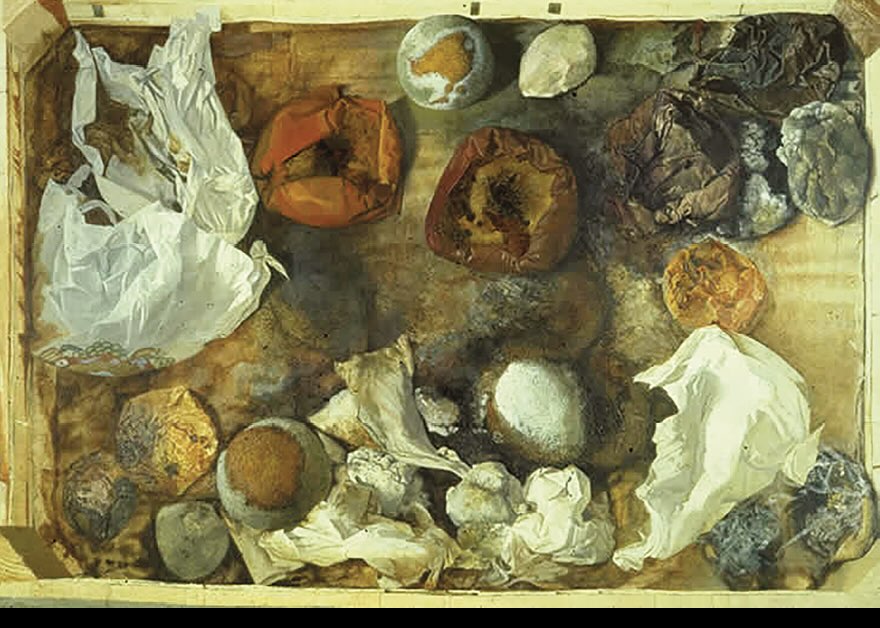
Our winter evenings were full of heated discussions: there was no room for complacency, only the urgent need to understand the fundamentals of art through authentic dialog. Wolfango introduced me to the sculptors Paolo Gualandi and Bruno Bandoli, who in the ‘90s founded the School of Applied Sculpture, where I was invited to teach iconography and iconology and where I developed my project regarding the translation of painting based on visual impairment. Wolfango had a powerful, not gentle view of humanity and nature: he felt its weight while at the same time grasping the miracle of regeneration. Determined and forceful, he could also be very tender, generous and pure. When I teach my students about his large-scale works, installed in the city center, in addition to La cassetta dei rifiuti (The Waste Bin), an evolving universe, what most impresses is Resurgo, an aluminum box containing human bones: a zenithal look at a cold metal urn that Wolfango kept for lengthy contemplation. It contains a skull, almost cradled by hip bones. In this recomposition, the thigh bones are next to the humeri, and curved bones emerge from darkness, creating a horizontal figure eight, the symbol of infinity. I see him once again, in this pitiless and moving vision. I think of his children, Alighiera and Davide, who preserve his memory, and I hear the incomparable lines of Dylan Thomas:
(…) And you, my father, there on the sad height, Curse, bless, me now with your fierce tears, I pray. Do not go gentle into that good night. Rage, rage against the dying of the light.
 Italiano
.jpg "Vedere Oltre - Miniatura di copertina")



.png "Aderente alla Consulta tra le Antiche Istituzioni Bolognesi")