Women’s suffrage, granting first the right to vote and then electability, became law when Italy had not yet been fully liberated. Lieutenant’s Decree no. 23 of 1 February 1945, emanated by the Bonomi government, “Extension to women of the right to vote,” acknowledges the active role played by women in antifascism and in the Resistance during 20 years of negation of democratic liberties. Women’s entry in social and political life signified progress for Italian democracy and for modernization of the entire country, as well as for the generations of young people born under fascism and who exercised the right to vote for the first time.
The right to vote was the foundation of the new law anticipating the national elections of 2 June 1946 and the Republic, a result of the maturity and collective political conscience of the female “masses” that marked a break with the past and aspired to equal rights in the family and at the workplace. A demand for emancipation after fascism’s negation of the image of women, relegated to marginal and stereotyped roles in society and the family.
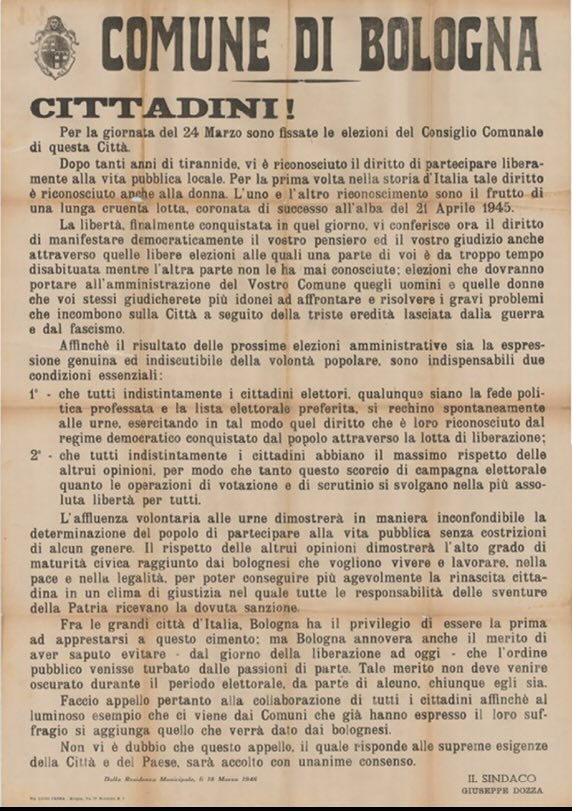
In Bologna, women voted for the first time on 24 March 1946 at elections for the city government, the ideal representative of the new society, symbol of the city, the meeting place for all efforts to reinstate moral, civic, economic, and institutional life. The manifesto for the convocation stated that “for the first time in the history of Italy, this right is also granted to women” to demonstrate “in an unmistakable manner” the people’s determination to express themselves without restrictions, for a more just society.
Out of the sixty councilors elected in 1946, four were women, representing the two largest parties: two out of 24 for the Communist Party and two out of 19 for the Christian Democrats: Ester Capponi, Communist Party, teacher, born in 1890; Giovanna Gardini, Christian Democrats, teacher, born in 1892; Anna Serra, Christian Democrats, teacher, born in 1894; Vittorina Tarozzi, Communist Party, shop assistant, born in 1918.
The first three belonged to the generation that took part in the Resistance as adults, their level of education and background ensuring solid and knowledgeable participation. Ester Capponi was an activist in the teacher’s union in the early ‘20s, and was forced to leave teaching and emigrate to France. Vittorina Tarozzi, nom de guerre "Gianna," partisan in the 63rd brigade Bolero Garibaldi, represented the new, the young generation that had no knowledge of the pre-fascist period. Together, they were responsible for housing, childcare, school meals, charitable institutions, consumer prices, summer camps for children, and construction of new schools in the outskirts.
At the end of their term in office, and with the onset of the Cold War, they focused, very resolutely, on the subject of peace. As representatives of Bolognese women, they addressed the entire council so that “beyond any political ideology and religion” it might express ”the will to prevent a new conflict and new massacres.”
 Italiano
.jpg "Vedere Oltre - Miniatura di copertina")



.png "Aderente alla Consulta tra le Antiche Istituzioni Bolognesi")