When we were offered, in collaboration with Bologna’s historic coffee company “Esse Caffè,” a chance to organize a tasting course for people with visual impairments, emotions ran high.
But then came the usual doubt about every good idea: how many people would be interested?
We sent out the invitations with fingers crossed.
In truth, not knowing if anyone will answer is one of the most underestimated thrills of cultural organization, a real challenge.
We wondered, who could ever be interested?
In no time at all, we passed the set number of requests and reluctantly had to close the registrations in advance!
Obviously, coffee (good coffee) doesn’t need to be seen to be interesting.
The first day of the course, held in the rooms of the Cavazza Residence on via Arienti in Bologna, began with presentation of the “Essse Caffè” company by its owners and directors.
And since the world is as small as a cup of espresso, one of the owners told us that she had once worked as a reader for the blind at the Cavazza Institute!
Coincidence? No, the aroma of destiny.
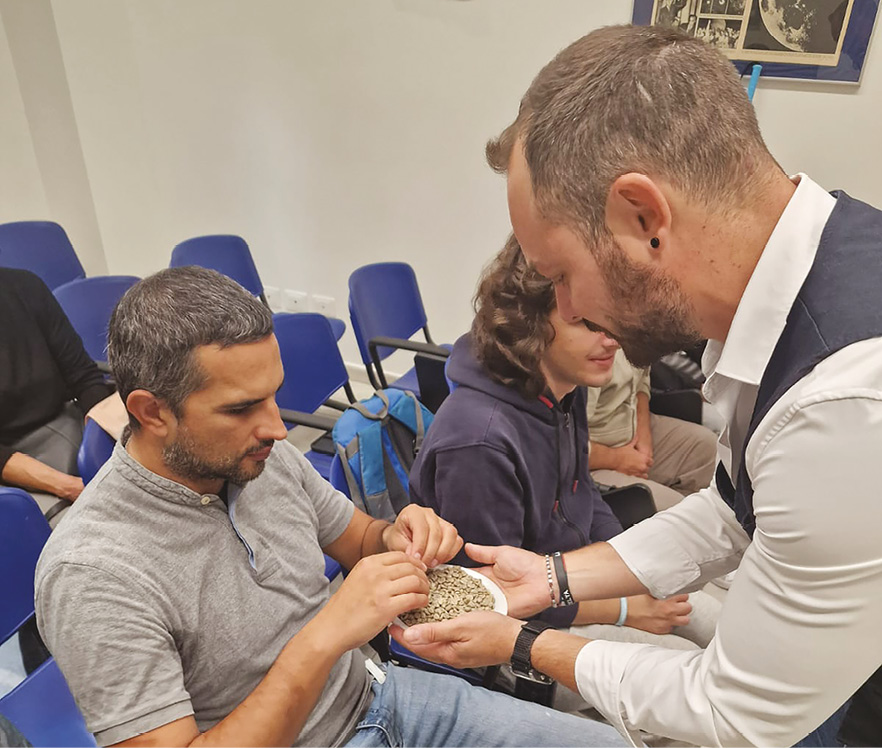
After the presentation, the participants were divided into two groups.
The first, led by Coffee Master and Brand Ambassador Vito Campanelli, focused on tasting: aromas, flavors, sensations.
The experience was exciting, at times destabilizing, and above all instructive.
We learned that real coffee has three “C”s, but for the sake of modesty it’s better not to specify what they are!
The second, led by Thomas Pranzini, Coffee Master and Head of Quality Control, focused on production: selection, processing, and roasting of beans, discovering all of the science and culture behind a cup so casually drunk at the counter.
At a certain point, the course naturally ended. We said goodbye, our smiles a bit tense and our hands trembling slightly from caffeine, in a cordial atmosphere of collective agitation.
Outside the Residence, some started running to work off their excess energy, while others hopped and skipped as if they had just had a mystical illumination.
A few were seen prancing in the Bologna hills, while others, still over-stimulated, returned home and conducted friendly conversations along the way with porticos, columns, and capitals, and even received profound philosophical replies.
An unmistakable sign that the course had worked: not only did we learn to recognize a good cup of coffee, we also discovered how surprisingly loquacious it can make our beautiful city’s architectural heritage.
 Italiano
.jpg "Vedere Oltre - Miniatura di copertina")



.png "Aderente alla Consulta tra le Antiche Istituzioni Bolognesi")