Founded in Bologna in 1990, the “Casa delle donne per non subire violenza” association (in Via Massenzio Masia 19/A), is now an absolute reference point that offers support and counselling to women who have suffered violence. Since its founding, the Centre has helped over 17 thousand women (931 in 2025), a constantly growing number that testifies to the persistence of gender violence, but also to the trust in services that offer support and hospitality to women and minors, as well as psychological and legal consulting, job counselling, support groups, and reception of third-party reports. Among the country’s most highly-experienced anti-violence Centres, the "Casa delle donne per non subire violenza" in Bologna works actively with national and European networks and institutions to develop shared countermeasures. We discuss this with Anna Pramstrahler, the association’s founder and long-time activist.
How do you view the trend in public opinion regarding gender violence?
A lot has changed in the last 30 years, with greater sensitivity to the question. We know that male violence against women has been part of our patriarchal societies for thousands of years. What has changed is that it has emerged from silence: women have begun to say “Stop!”

Is the Italian regulatory framework adequate?
At first, Italy was quite inadequate, but in recent decades it has adopted many international laws that were considered highly advanced. Just remember the “Rape Trial” in 1979, where the victims were accused and the perpetrators defended, and that it was only in 1996 that rape became a crime against the person instead of against “public morals.” The so-called anti-femicide decree was approved only in 2013. This measure made it easier to remove a violent husband from the home and prohibit him from approaching places frequented by the victim and her children. The Red Code was approved in 2019, making it easier for victims to report violence. Subsequent additions included crimes such as revenge porn, disfigurement of the face, and violation of the order to leave.
What are the weak points of this system?
As confirmed by the latest ISTAT survey, 10% of women report violence. There is great mistrust in the legal system, but on the other hand more and more women are contacting anti-violence centres, which, according to ISTAT, have almost doubled in number.
How many anti-violence centres are in the Di.RE network?
There are now 88, but with a territorial gap between north and south. One of the critical points is the training of professionals who come into contact with women: police officers, judges, social workers, emergency room staff.
Violence against women with disabilities is a phenomenon that is still largely hidden. Based on your experience, how do you evaluate it?
For many years, anti-violence centres use an intersectional approach that considers women’s diverse identities, discriminations suffered, hardships, etc. The main strategy is to provide specific training to shelter professionals.
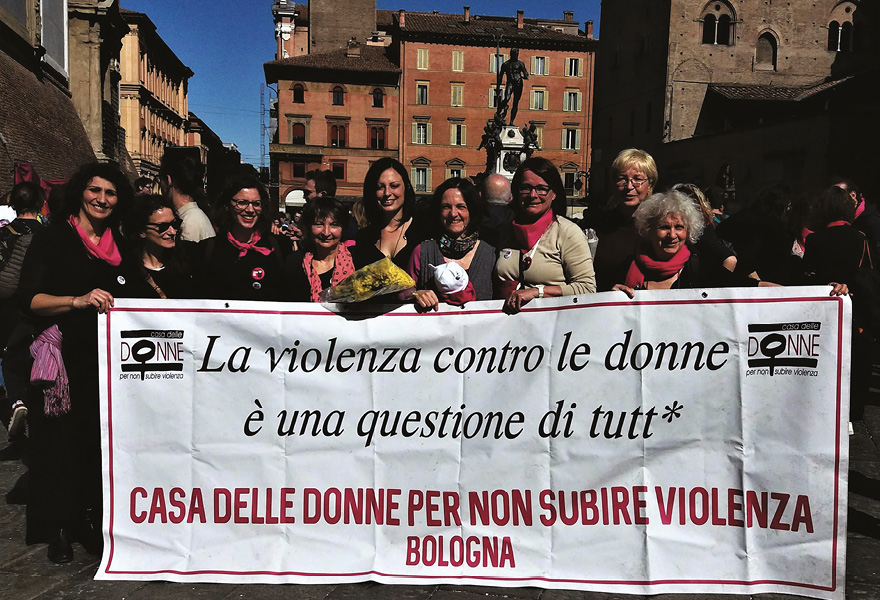
What is the situation at your centre in Bologna?
Our move to via Masia solved a structural problem, that is, physical barriers at the entrance. However, not all safe houses are accessible by everyone. During the pandemic, we launched a WhatsApp service for deaf and hearing-impaired women and made arrangements to find an Italian Sign Language interpreter for consultations. We also conducted initiatives with blind and sight-impaired women in collaboration with the Italian Union of the Blind and Partially Sighted.
What initiatives do you consider most effective for deconstructing the culture of violence?
One primary and essential action is making existence of the anti-violence centre as widely known as possible, even just the telephone number and address.
What are your plans and prospects for the future?
The main issue has always been economic uncertainty. For years, we have requested structural funds and recognition as essential services (the same as an emergency room or a social service). The aim is to provide job security to trained professionals and allow long-term planning.
tel. 051-333173
 Italiano
.jpg "Vedere Oltre - Miniatura di copertina")



.png "Aderente alla Consulta tra le Antiche Istituzioni Bolognesi")