In early July 1944, a secret meeting in the home of Count Filippo Cavazza on via Farini approved the participation of Catholics and Liberals in the antifascist front, an “unconditional” decision that marked a new political and organizational stage in the fight for freedom and the end of the war.
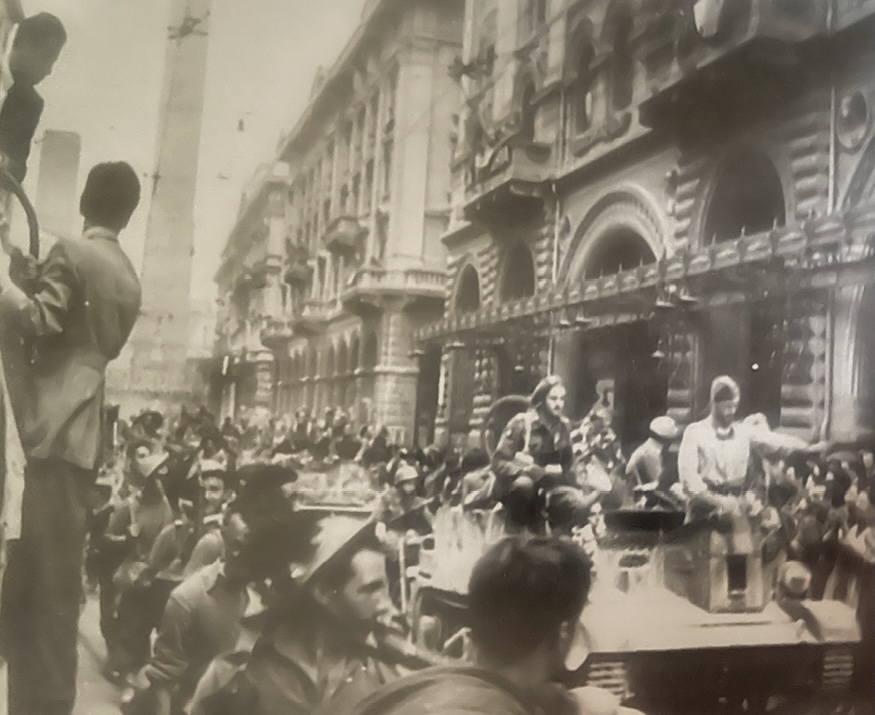
.jpg "The liberation of Bologna - 21 April 1945")
The decision to join the Action Party, the Socialist Part, and the Communist Party derived from a precise political choice, made by the Catholics a few months before, to give wide-ranging authority and strength to the Resistance. Paolo Betti represented the Communist Party, Antonio Zoccoli the Liberals, in addition to Paolo Fortunati, communist, esteemed by Cavazza for his intellectual activism in the city’s cultural and university circles. Count Filippo Cavazza, 58 years old, represented the Catholic movement in the regional National Liberation Committee as an “authentic democrat” who, from the very beginning of fascism, rejected the regime’s dogmatism and violence. Although he had not yet taken part in any political movement, Cavazza accepted the role in the name of all Italians united for freedom, certain that he could collaborate to fight fascism and the great enemy of all freedoms in Italy: German arrogance. Born in 1886, aristocratic and wealthy, he was raised in a family of strong religious faith and described himself as a “social Christian.” He had great respect for people who worked in the fields, and was in favor of modernizing agriculture as well as of social representation. The heir to Francesco, founder of the Institute for the Blind, and adjunct professor of zoology and zootechnics at the University until 26 June 1935, when he did not pledge loyalty to the regime and “regretfully” resigned from the University, he held numerous roles both in public institutions and as the employer of farm workers, with whom he tried to promote a progressive and collaborative, not unyielding, position.
The deaths of his wife Lina and his son Franco sadly marked the path taken up to that time, which took the form of active political opposition after Pope Pius XII’s speech of 24 December 1942, which urged Catholics to act “honestly and willingly” for a new order. Cavazza strengthened his relations with antifascists in close collaboration with Fulvio Milani, with whom he formed a strong personal and political relationship to provide the “Christian and Italian” contribution to ensure that the country would never again fall into fascism. The CLN held its meetings at the Institute for the Blind, a safe haven for Jews such as Egle Tedeschi and the three Basilea sisters - Sandra, Maria Luisa, Elena – along with their mother Amalia Levi, all protected by Paolo Bentivoglio, head of the Institute and founder of the Italian Union of the Blind and Partially Sighted, professor and socialist, recipient of the Silver Medal for Civil Valor with his wife Teresa Anzolla. Likewise, at the Cavazza home in San Martino dei Manzoli, near Minerbio, hospitality and refuge were offered to persecuted politicians such as Mario Finzi and his family, and Gian Giuseppe Palmieri. At the City Council meeting of 12 January 1953, Filippo Cavazza was commemorated as a “shining example” of someone who, in times in which one could not remain silent, answered widespread appeals for help and social duty.
 Italiano



.png "Aderente alla Consulta tra le Antiche Istituzioni Bolognesi")