This year as well, the Francesco Cavazza Institute’s Educational Consulting Service took advantage of I.Ri.Fo.R.’s "G.E.S.T.I. per crescere 2025" announcement to organize a two-day laboratory for blind and visually-impaired children in the last year of nursery school and in the first year of elementary school.
The aim of the laboratory, called “Inside the stories,” was to launch and stimulate these children to read by proposing a rich and exciting experience.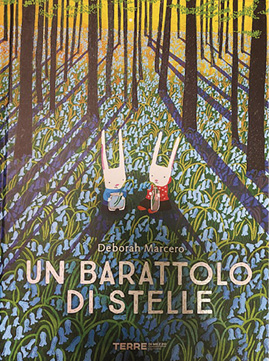
The laboratory was designed and led by Paola Gamberini (coordinator and typhlo-pedagogical professional), Serena Cimini (psychologist), Martina Belvisi (specialized educator), and Fabio Fornasari (curator of the Institute’s Tolomeo Museum).
The illustrated book “Un barattolo di stelle” (“A jar of stars”) by Deborah Marcero (Terre di mezzo, publisher) – that tells of a child who collects special objects and memories in jars – focuses attention on the importance of giving value to one’s experiences, conserving their memory and significance by means of objects. In this way, our inner reality is also represented as an intimate, protected place in which we conserve experiences and emotions that we may share and exchange with friends, staying in contact with them even if they’re far away. The proposed activities were therefore focused on awareness of one’s experiences and on reciprocal listening to stories, personal experiences, memories, and wishes, seeking to have the children realize the importance of not losing the traces (tangible or intangible) of their experiences, of giving them value and treasuring them, not merely consuming them. The activities also sought to focus the children’s attention on their emotions, as well as to promote and facilitate empathy and the ability to put themselves in another child’s shoes and overcome their childhood selfishness.
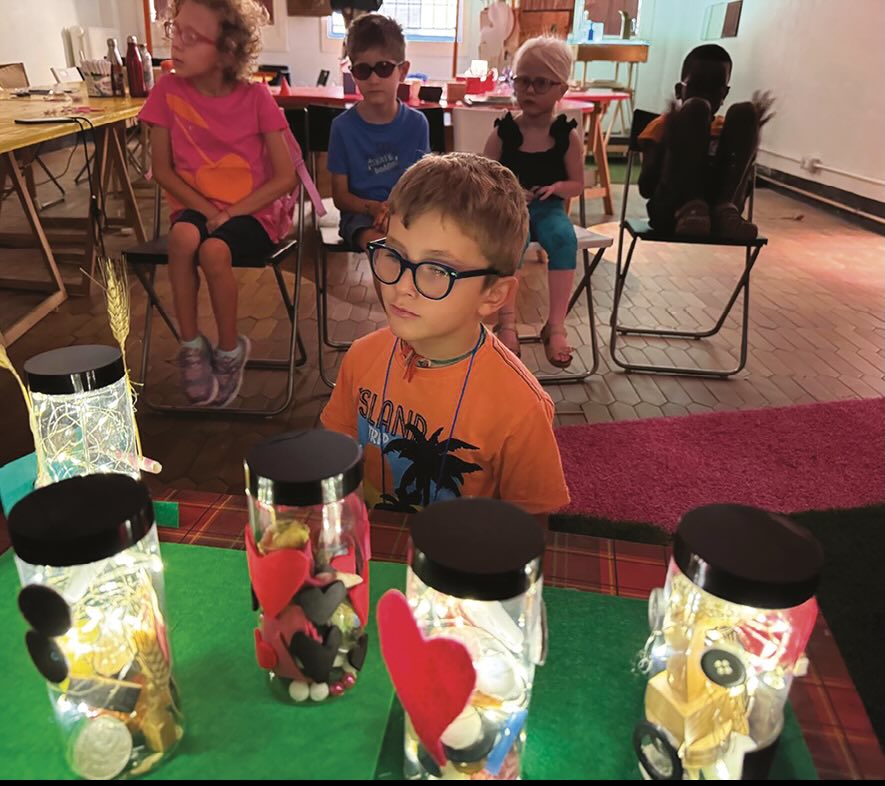
We took the time needed to listen to the story and understand its deep meaning, including with the help of images (or their description). The reading was the starting point for manual and creative, play-base motor, and body image activities. The story’s subject brought the children into contact with their inner reality, experiences, emotions, and wishes. Each child created and took home their own “jar of stars”: a container of symbolic objects, full of meaning and emotional resonance. Each child shared with the group the meaning and value of the objects chosen for their personal jar. At the conclusion of the two-day laboratory, the children also had a chance to enter a gigantic jar: an ideal container of memories, wishes, and emotions to discover and share.

The 6 children participated with great interest and enthusiasm, ready and willing to open up, share, and talk about themselves. For some, this was their first experience with other visually-impaired children.
The story read out loud was also printed in Braille and in large print as an incentive to read for the children who use these codes.
 Italiano
.jpg "Vedere Oltre - Miniatura di copertina")


.png "Aderente alla Consulta tra le Antiche Istituzioni Bolognesi")