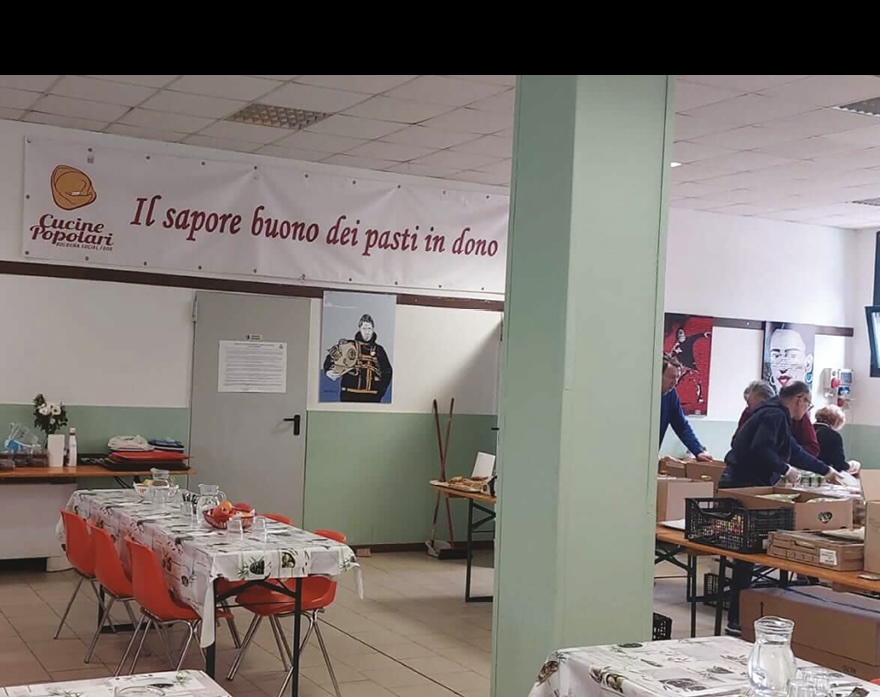
In recent years, Bologna, which has always been famous for its fine food, has also become known for its virtuous food: that of its Community Kitchens. Launched in 2015 by the Civibo Odv community volunteer organization, it is now a major entity. Open in four neighborhoods (Navile, San Donato, Porto-Saragozza, and Savena), they are places where people in difficult situations find not only tables set with dignity and warmth, but also an opportunity to socialize, make friends, and build new relations. We ask Roberto Morgantini and Elvira Segreto, two of its founders, how their wonderful project works.

What is your philosophy?
The Kitchens are based on a dream we’ve had for years and that we managed to create thanks to help received from many volunteers and funds contributed by many local companies. It now seems to be an example of reception and inclusion without equal anywhere in Italy. Its new element – our real strong point and true identity compared with other systems of solidarity and support – is its method. We have eliminated the element of charity, making every effort keep people from feeling poor or “different,” to focus not on altruism at our tables, but instead on a feeling of inclusion. These people are our guests, and during meals they can chat and build relations. Guests and volunteers are on a first-name basis, and this is the point: food is a means to create a network around the problems of poverty and loneliness, unfortunately still very serious here in the city.
Have your types of guests changed since 2015?
Yes, especially due to Covid. In addition to the social groups who received our support – the homeless, the unemployed too old to find a job, retired persons on a minimum pension, the elderly without a partner – there are the new poor generated by Covid. We had to find a way to manage this increase in need, made more difficult by all the restrictions. Covid forced us to adopt the take-away method, which removed a crucial element: socializing among our guests and volunteers during meals. Our spaces are now gradually filling again with the splendor that originally inspired us. We managed to face these critical months thanks to our volunteers and to the extraordinary solidarity of our city.
Is Bologna an inclusive city?
I have to admit that the city seems a bit distracted from its traditional solidarity and inclusiveness. One senses increased diffidence, a lack of trust in the disadvantaged, a sort of fear of the poor. This climate has no doubt been worsened by a worldwide political and social situation which, through the media, gives the feeling of a deprivation of humanity, of a loss of values and of the value of life. But Bologna is still a vital city of planning and inclusion, of opportunity and welcome. Many residents contact us to help us work.
Plans for the future?
The volunteers in our Kitchens radiate such an intense emotional charge that unrepeatable emotions are added daily to our experience of solidarity.
So far – and with great difficulty – we operate in four neighborhoods, a sign of increasing data on conditions of poverty and isolation in the city. We are counting on offsetting this phenomenon by expanding our activities to other neighborhoods of Bologna. This will require significant investments. But our real goal is to achieve the conditions for closing all of the Kitchens. This would mean that no one has been left behind, that poverty has been defeated with a job and a home – with dignity – for everyone. But we want this goal to be offered by society, not imposed.
.
 Italiano
.jpg "Vedere Oltre - Miniatura di copertina")



.png "Aderente alla Consulta tra le Antiche Istituzioni Bolognesi")