To celebrate the 8th centenary of St. Francis’s death, we decided to talk about music in an unexpected way: not medieval laudae (vernacular sacred songs), no discussion of famous Franciscan musicians in Bologna, but instead an entirely 20th-century journey with three stops, a mixture of Franciscans, Bologna, music, and children. In other words, we’ll dedicate the year to Lo Zecchino d'Oro and its stars: the Children’s Choir and its great first conductor, Mariele Ventre.
The International Children’s Song Festival, better known to everyone as “Zecchino d’Oro,” now permanently linked to Bologna’s Antoniano Institute, began not in Bologna but in the studios of the Milan Trade Fair in September 1959. Cino Tortorella (already known on children’s TV as Zurlì the Wizard) had the idea, as well as the insight (inspired directly by The Adventures of Pinocchio) of awarding a pure gold coin (a zecchino) as a prize. It was no coincidence that the first great success of that edition, Letter to Pinocchio, became famous well beyond the realm of children’s songs thanks to Johnny Dorelli’s unforgettable performance. In 1961, after two experimental editions and expiration of the contract with Milan, the festival moved permanently to Bologna after a successful meeting among Cino Tortorella, the Antoniano monks, and a young musician named Mariele Ventre.
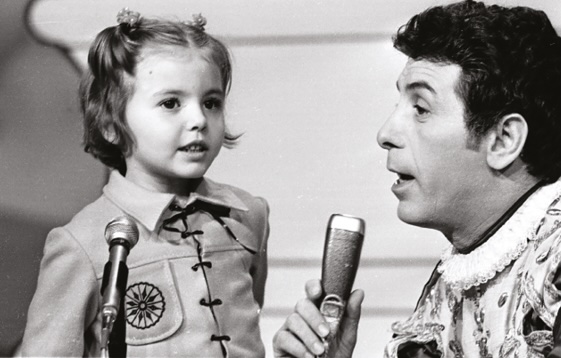
Those of our age remember every edition, every moment on the black&white TV, and if our parents liked it, they bought the 33 rpm records with all the songs of the “zecchino” (you just said the word and everyone understood); if they really liked it (as I did),father recorded the songs off the TV (with an enormous Philips wired to an equally enormous television) so they could listen again right away. And if they REALLY REALLY liked it, you might even go to the Antoniano one day to see a live performance, hear the children sing, and laugh at the clumsy entrances of Ricchetto, shouting and arguing with the “pedantic” Wizard.
So, for over 60 years, the childhood universe has been populated by the Zecchino’s unlikely animals: cats (black or white, many or few), the fly that waltzes and the flea that dances the hullygully, crocodiles whose sounds are unknown, or lost unicorns. Plus the collection of even more unlikely characters, such as Popoff who saves everything by rolling, Camomillo the bullfighter, Topozorro and his pecorino cheese, Peppina with her mysterious blends of coffee, and Grandma Pina with her wonderful noodles. We rarely remember who performed the songs, but we still sing them. Some have become jingles for TV programs or even popular sayings.
To conclude this brief recollection of a great story, let’s not forget that after Cino Tortorella-Zurlì the Wizard (with the inseparable Topo Gigio), the hosts of this evergreen Festival included personalities such as Maria Teresa Ruta, Fabrizio Frizzi, Carlo Conti, Anna Falchi, Roberto Ciufoli, Massimo Giletti, Milly Carlucci, Marisa Laurito, and Nino Frassica. And of course, alongside the guests, performers, and hosts, there was – and still is – another great star: the Children’s Choir, to which we’ll devote the next chapter of this story.
 Italiano



.png "Aderente alla Consulta tra le Antiche Istituzioni Bolognesi")