|
The Bridges of History by Paola Emilia Rubbi Architectural jewels, witnesses of a legendary past.
| |
|
Let us put aside Venice
with its huge number of ancient, historical and fascinating bridges, known
all over the world. Let us not consider the Ponte Vecchio in Florence, or
the wooden Ponte di Bassano heard in so many songs, unconditional tourist
destinations. Instead, let us find bridges that, in terms of antiquity and
history, have nothing to envy their very well known "brothers", but that
are, because of their secluded Appennine location, more unknown. This is a
true injustice because the Ponte Gobbo (Gobbo Bridge), or the Ponte del
Diavolo (Devil's Bridge), built over the Trebbia river of Piacenza, is one
of the fascinating surprises filled with history and architecture that
Bobbio keeps for its visitors. Bobbio was called Ebovium, and it was a
small area when, in 614, Colombano, an Irish brother, built there the
first core of what would later become a large monastic centre. It was a
lighthouse of culture with the most important library of the High Medieval
times. In Bobbio, a small city rich with history and memory, of the
ancient Benedictine abbey, founded by Saint Colombano, there remains some
parts of the factory and, mounting the Trebbia, is the bridge, a true
jewel of architecture. Called Gobbo Bridge, it is 280 meters long, 3
meters wide, and it is composed of 11 dissimilar arches (the widest one
measuring 32 meters). Even though, as it is said, its origins date back to
the Romans, its existence is documented with certainty from 1196. Damaged
by the Trebbia's fury, it was then extended in the years 500 and 600,
serving as a transit to the area of the salt mines, it still preserves
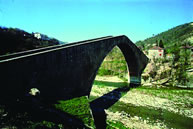
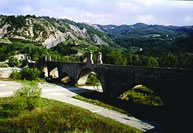
Romanic and medieval elements. Around this very ancient, original and fascinating realization exists a multi-century legend from which derived an ulterior name: the Devil's Bridge. It is said that when the Trebbia pratically destroyed the bridge, Satan "offered" Saint Colombano to rebuild it in one night, but to one condition: he, the Devil, would take the first person passing on the newly-built bridge. The Irish saint accepted. Satan rebuilt the bridge in one night, but Colombani fooled him by having a huge brown bear pass the bridge, a bear that he had domesticated a few days before to help him pull a plough. The Devil was left without the soul he wanted so much, and Saint Colombano had the bridge reconstructed in only twelve hours! It is necessary to go down the Appennines of Piacenza in those of Bologna, in the Valley of Santerno, to see the other medieval bridge, the pride of a city that is rich of history and testimonies for having been for centuries the undisputed feud of the Alidosi family: the Castel del Rio (the Castrum Rivi of Romans) of which it was first heard of in 1179. From the first feudatories' castle, now called the Castelaccio, rubbles (however remarkable) can be found on the hill while from the city rises the powerful mass of the rampart of the most recent Alidosi palace, which began to be built at the beginning of the 16th century, a square plan attributed to Bramante. It remained unfinished and in the year 600 it was partly demolished, but it was superbly restructured and today houses an interesting war museum. And the bridge? The bridge, also called "the Alidosi's", or the "Ponte d'Osta", is almost hiding underneath the palace, and is linking the Santerno riverbanks. Commissioned by Obizzo Alidosi, Andrea di Guerrerio of Imola built it in 1499: a unique arch with a very pronounced "back of a donkey" (42 meters). There are some practicable openings with engineering functionalities which alleviate the nature of the construction. To walk on it to reach the small church of Osta, which also belonged to the Alidosi, is an emotion bringing us out of time. Since we are in the Appennines of Romagna, let us visit Modigliana, at the confluence of torrents Acerreta, Tramazzo and Ibola together forming the Marzeno. Modigliana, where Garibaldi took refuge in the home of Giovanni Verità during his escape to Tirreno, is probably the Castrum Mutilum recalled by Livio, and it is evocative and peculiar for the environmental tone of the historical centre and its multiple bridges. From the one over the Acerreta, at the end of the city, it is possible to observe other three bridges; one of them to the left dates back to the 18th century. |
|