Low Vision and Learning
by Federico Bartolomei and Mario Barbuto
Educational counselling service for children living with vision loss.
A person with low vision
is, by definition, living with an irreversible visual impairment, which
cannot be improved with conventional optical systems. It is so to such a
degree that will not allow performance of common daily life activities.
During the years of development and schooling, the visual
functionality is closely correlated to the global evolution of the child,
in his perceptual, psychomotor and neuropsychology dimensions,
three aspects closely linked together. On the basis of this preamble,
it is obvious that a severe congenital or early defect in any
functional environment cannot be considered alone. It inevitably
interferes with the development of other functionalities or
subfunctionalities, involving the functioning and psychological
elements, consequently limiting participation in social
life.
Therefore, the rehabilitative treatment has to anticipate a
series of interventions at the health, social, psychological and
environmental levels. In other words, this means that the integrated
process needs to involve closely related strategies that will maximize all
of the individual's residual resources, adapting the environmental,
structural and social characteristics, and also managing the eventual
psychological repercussions.
The definition and quantification of a
visually impaired child's residual abilities requires more often than not
a multiexpert and multidisciplinary approach to outline the
rehabilitative program. To better understand a visual limitation, it
means that generally a child will see little and not well with both eyes,
from a distance or from up close, even with the use of glasses, with a
visual acuity equal to a maximum of 30%, and a field vision equal to 60
% compared to children the same age. The child will therefore have a
lot of difficulty looking at images and reading small print, or be
limited regarding orientation and mobility.
The limitations
mentionned above are closely linked to the nature of the visual
impairment. There can be central vision deterioration with
consequencial difficulties with reading and interpreting details in
images, or deterioration of the peripheral vision where space is perceived
in a more narrow fashion, like a tube, which makes mobility and object
interpretation difficult. From the typhlo-pedagogical and rehabilitative
point of view, to confront these problems means that a close collaboration
needs to be put in place between the family, the school, and the
professionals who deal with the treatment and rehabilitation aspects of
the individual.
We have already discussed the numerous and significant
consequences on the quality of the overall development of the child that
an impairment can cause, but maybe some considerations and a few
examples, from pedagogical experiences, can bring more light into
it.
Learning, observing, comparing, associating, moving, in short, the
meaning and the pleasure of learning and expressing oneself, and the
building of self esteem are at risk when one experiences a sensorial,
perceptive and visual impairment.
The degree of these is not easy to
determine. At first, even the child can be of little help since
the visual condition he is experiencing is perceived as "normal" because
it is the only one that he knows. Most likely, the child has already
adopted some behaviour to compensate the visual impairment. School will
offer new and inevitable means of comparison and awareness of the various
possible performances. At school, a child with sight problems sitting far
away from the blackboard may not see it, which will result in learning
difficulties. He may not be able to take advantage of the educational
value of educational videos, or images and alphabet letters
on cardboard placed on the classroom walls. The child may not be able
to interpret rapidly mimics or gestures which support oral communication
of teachers and classmates. Consequences of difficulties with
near-sightedness are also indubitable: reading, writing, and drawing
difficulties. This creates great tiredness and lost opportunities for
reinforcement, control and fulfilment.
In all these cases, "school
performance" is affected by the gravity of the impairment. To reach
adequate results according to school expectations, the student
will have to double the efforts much more than sighted
classmates. An enormous quantity and quality of information is lost. This
lack of information can reduce experience and strengths and have a
significant impact on the learning experience. To compensate, it may be
possible to set up different educational programs.
In the presence of
a severe visual impairment, even a simple homework where the student needs
to recognize and link two dots on a piece of paper becomes a task
requiring perseverance and skill.
When vision is limited, putting
together a photographic context, a geographical or artistic image requires
a demanding and intense activity of organizing the perceived elements and,
only with a lot of work, is it possible to outline a synthetic mental
representation of the whole image.
Sometimes there can also be a
change in chromatic perception: a colour can be mixed with another,
limiting the ability to identify an object from the background. On the
physical geography map, the little red balls indicating cities disappear
in the green prairies, the blue Po with its affluents is not longer found
in-between valleys and at the foot of the Alps, and at the end of its
journey the mouth on the Adriatic coast is lost in some grey
similar to the blue of the sea. The first example of a sentence analysis
on the blackboard, with the subject written in green, the verb in red and
the complement in blue, becomes a grey puzzle which is resolved only with
much attention to oral explanations.
Some pathologies can create
difficulties in adapting to light with symptoms similar to photophobia and
dazzlement, the child is not able to stand lighting which would be
pleasant to others. In class, it is possible to use window curtains or to
have the child sit far away from the windows. Difficulties in adapting to
dark places can lead to a symptom called "hemeralopia"
(day-blindness) a reduced vision when light fades away: in class, the
other students will appear to be in the darkness when there is less
light.
The child reaches literacy through an experience which begins
the first months of his life until formal training. Even the
writing experience does not appear by magic at the age of six. It is
the result of the cognitive, psychological and psychomotor development
journey that the child begins way before he is shown the first letters of
the alphabet. It is fundamental to understand that learning does not
relate to what is taught only, but it is based on the ideas and knowledge
that the child has built himself while spontaneously playing, while
interacting with others and the environment. Consequently, the learning
path cannot be standardized. It has to stem from that specific situation,
in school or not, and from information that is shared from time to
time.
Aids will be chosen not on the basis of chronological age or the
school year a child is in. It is important to emphasize that the
methodological choice is guided by the student's own potential, ability,
and requirements in that moment and for a given task.
It is important
to succeed in working with the child to find the right devices which will
be useful. It means adapting or modifying a procedure intended for a large
audience and make it efficient for one person.
In the various learning
situations, it is nevertheless important to preserve the emotional value,
the pleasant feeling of entertainment, the pleasure to do things, the free
investment of mental energy for a desired goal.
In regards to aids for
persons with low vision, except in severe cases where it will be necessary
to proceed by degree with the teaching of Braille, the tools that are used
are generally to enlarge characters and images or to obtain images
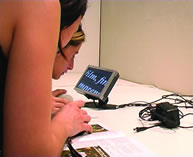
electronically. Basic aids are: textbooks with large print and notebooks
with wide spacing, CCTVs and large screen software with voice synthesis to
use with the personal computer. The transcription of texts or duplicated
lecture notes in Braille or in large print are done by organizations which
provide schools with the material they request.
Some tools
are usable by the whole class. The
map of the world, for example, can have raised contours and lines. It can
be in colour (for students with low vision and the rest of the class). It
is easily read with the fingers as well as with the eyes. It has two
legends at the bottom, about continents and oceans, written in Braille as
well as in print, and it becomes an instrument of integration for
regular teachers and special educators as well as students.
In order to
be used by visually impaired students, some tools have high level
chromatic contrasts between the text and the background or
images.
There are other raised-line material used for tables or
graphics in various disciplines and which are reproduced in Thermoform (a
technique used to create raised forms or lines on a special paper).
The
hands-on experience of situations, objects and tools (not only what others
say about them) is essential for the visually impaired to develop mental
images of the reality, concrete knowledge of what they learn. Therefore,
it is fundamental to begin with real and concrete elements, in order to
gradually arrive at a symbolic representation, using all possible material
and tools to represent an object, to describe a discipline and to keep the
student participating as much as possible and as in much harmony as
possible with the rest of the class.
Even for drawing there are various
tools, some for bidimensional representation of the first objects known,
others are used for the reproduction of geometric shapes (eraser, ruler,
T-square, compass, etc.).
In conclusion, we believe it is useful to
mention that whatever activity is planned for the child, it has to start
from subjectivity, otherwise there is the risk of
facing qualitative and quantitative obstacles: qualitative when
functional objectives are imposed by a standard protocol that is not
personalized; quantitative when work deadlines are postponed indefinitely
with the illusion that an objective can be reached without first
evaluating the child's potential. Educational aids, whether they are
designed for blind or low vision people, are tools that have a
value corresponding to the knowledge professionals have of
them and how well they use them in the context of a
global rehabilitative project.
References
Cannao M.1989,
"Ipovisione. I problemi dell'età evolutiva", in "Saggi", year XIV,
monographic issue. Cannao M., 1999. "La mente con gli occhiali", Milano.
Angeli Colombo E., "Disturbi visivi
complessi e didattica specializzata", 1984, Saggi. Delpino E., Gallo G.,
Gettani A., Pieri P. "Giocando s'impara. L'apprendimento della scrittura
nell'ipovisione". 1999, Istituto David Chiassone, Genova. Grassi N.
"Elementi di tiflodidattica. Giornale di ipovisione". Professional
Optometry. Vigneux F.