 to soften its potential faults. That is why I
wanted to ask influent individuals from the past who,
while travelling, lived in Bologna a while: some short comments on its
customs and its people. They are opinions which are signed by their
authors and which - like a bull's eye in a theatre - provide a light on the
reality of the ancient Emilian capital, helping us in a way understand what is
in that Bolognese DNA of ours.
to soften its potential faults. That is why I
wanted to ask influent individuals from the past who,
while travelling, lived in Bologna a while: some short comments on its
customs and its people. They are opinions which are signed by their
authors and which - like a bull's eye in a theatre - provide a light on the
reality of the ancient Emilian capital, helping us in a way understand what is
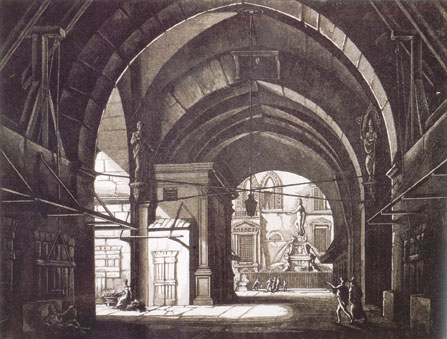
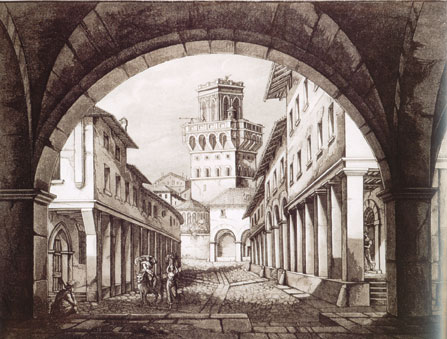
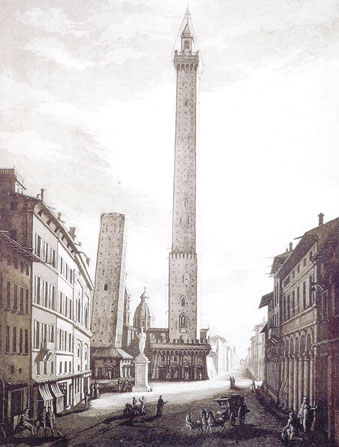
in that Bolognese DNA of ours.When Michel Eyquem De Montaigne - great French writer, author of the very famous work Essais - was in Bologna in 1580, he described her like this: … This is a city adorned with beautiful and wide porticoes with a large number of sumptuous palaces. We live here, as we do in Padova and in the cities around, in perfect living conditions; but this city is a little less quiet because of the old existing divisions between factions, one leaning towards the French, and the other towards the Spanish who live here in great number. There is a beautiful fountain in the square. We have seen in Bologna an ancient squared tower built to lean on one of its sides, menacing to collapse at any given moment.
 We have also seen the
University (the archi-gymnesium), which is the most beautiful building
I've seen for this use.
We have also seen the
University (the archi-gymnesium), which is the most beautiful building
I've seen for this use.Charles Dickens, the famous English narrator, author of David Copperfield, among other pieces of work, was also taken by the Garisenda. He visited Bologna in 1844 and wrote: The city has something grave and erudite about it, and it is immersed in such a pleasant shadowy light that it seems that only these two things are sufficient to remember her among many other cities, even if she would not particularly impress the traveller with her two leaning brick towers (each one of them being rather unsightly to say the truth). They are inclined askew as if bowing rigidly to each other, ending in an extraordinary way the perspective of some of the most narrow streets.
Goethe's father (Johann Caspar, who was imperial counsellor) while travelling to Italy, stopped in 1740 in Bologna and
 observed that:
The city holds justly her name of "the fat one" because one
can always eat so well here; in my pub there was
food prepared in French, Italian or German.
observed that:
The city holds justly her name of "the fat one" because one
can always eat so well here; in my pub there was
food prepared in French, Italian or German.Centuries pass and the good reputation of the Petronio table is not relenting. In 1914, Otto Von Taube, German author and historian, writes that: In Bologna, I was in the company of men with hearty appetites (…) and they talked, as far as I could undertand when they spoke Italian, of only three things: of good food, the joys of love, and the pleasure of music (…).
And, now, about the food in Bologna! What wine can equal the Lambrusco, this sweet dark red sparkling wine? In how many different ways is pasta prepared in Bologna? I tasted, with meat, thin yellow slices of pumpkin cooked in the oven. That is Bologna "the fat one".
Stendhal (or Henry Beyle, renowned French novelist, author, among other titles, of The Red and the Black) during his stay in Italy in 1816, notes that: Bologna is among the cities where hypocrisy is most difficult (…). As in London, there is a lot of freedom of opinion in conversations; but with the difference that, there, the tone is philosophical and weighty, while here it is easy and spirited. Many of the things freely expressed here in Bologna would scandalize the good society of Portland Place.
The habit of using latin quotations is still very present while the language has not crossed the Appennine (…).
But something else caught Stendhal's attention: Bologna is a city of 60,000 inhabitants (we are still in 1816 – 17; NfA), a city of spirit where women are prudish, and where there is laughter, given that women judge a man in less than three minutes. In fact, women speak with candor of love and of the handsomeness they prefer (...). There may not be in all of Bologna a woman who has not loved in an original way (…). In Bologna, love and play are the fashionable passions, music and paintings a leisure, and politics, under Napoleon, is ambition, a refuge for unfortunate lovers (…). Among the women of Bologna, I found two or three types of beauty and talent that I did not know existed.
All in all, for the great French writer as for the university students, the goliards of the twentieth century: Long live Bologna, the city of beautiful women!